How It Works

We equip Pre-K–12 schools with the access, plan, and routine to teach positive psychology's 24 character strengths and empower their students to build positive relationships.

Step 1

Access

Becoming a Partner School unlocks staff-wide access to P2's resources — Tier 1 daily lessons, Tier 2 and 3 resources, P2 for Families, P2 for Educators, P2 PBL, and more — all shared via Google Drive.

Have your staff roster ready: a spreadsheet with first name, last name, and email. Your leadership team submits it, and then tells your staff their access is live. Staff who arrive throughout the year get added the same way.

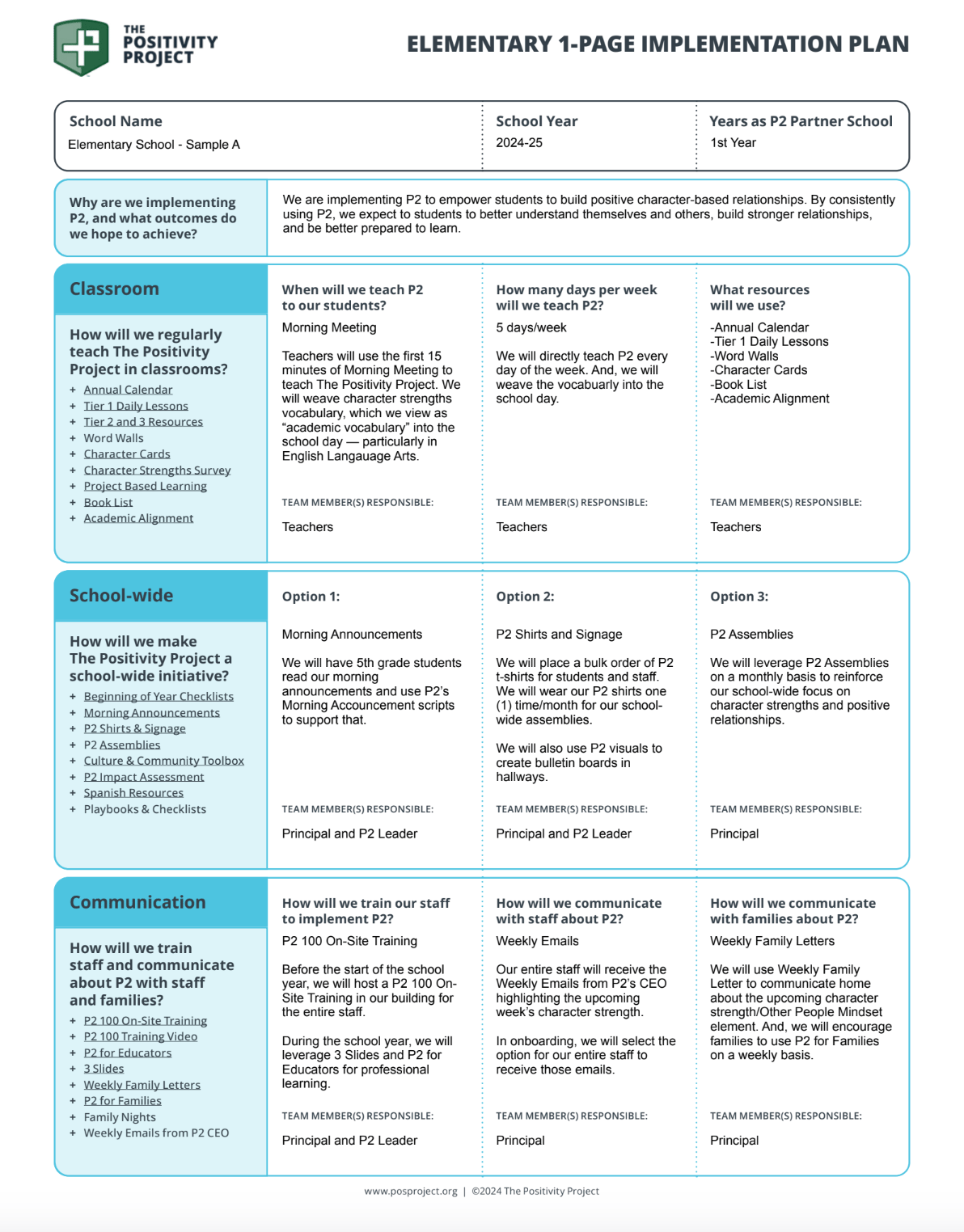
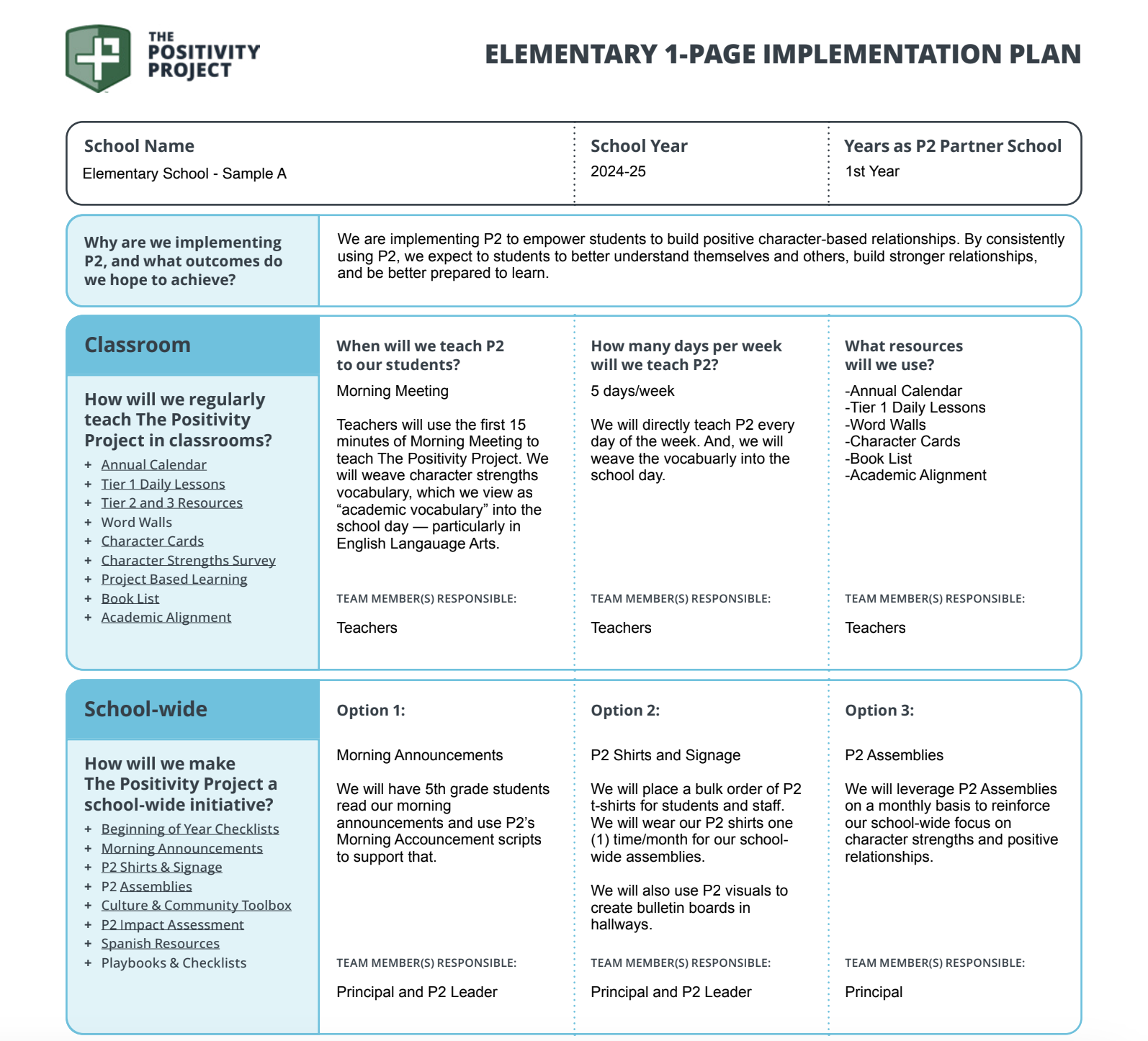
1-page implementation plan
See nine sample plans, differentiated for elementary, middle, and high school.
Step 2

Plan with P2

Access without a plan is where character education stalls. The 1-Page Implementation Plan is how your leadership team decides, on one page, what P2 looks like in your classrooms and schoolwide — and how you'll communicate P2 to staff and families.

You don't build it alone. Every Partner School gets an onboarding call with the P2 team, included in your partnership at no additional cost. Bring your principal, your P2 leader, and your implementation team. On that call, we work through your plan together and decide how you'll roll out P2 to your staff — whether that's your team self-facilitating, a 30- to 45-minute session we run with your staff, or on-site training in your building.

Then communicate the plan to everyone. The plan is ready when every staff member knows it — and it’s in their inbox, or on the wall.

Step 3

Routine

P2 is easy to teach. But you still need a plan, and a scheduled time. The lessons are minimal-prep, and any teacher can deliver them. What a school decides up front is who directly teaches P2 and when.

You'll have drafted your plan on your onboarding call. Now put the days and times in your plan and on your master schedule before the first week of school. Consistency matters more than any single lesson. Character becomes culture through repeated exposure and reinforcement—not through isolated events.

One program, Pre-K through 12

P2 runs on one annual calendar from Pre-K through 12th grade — every school teaching the same character strength the same week — with different daily lessons written for every grade level. In every grade, students understand, explain, and apply the character strengths to build positive relationships.

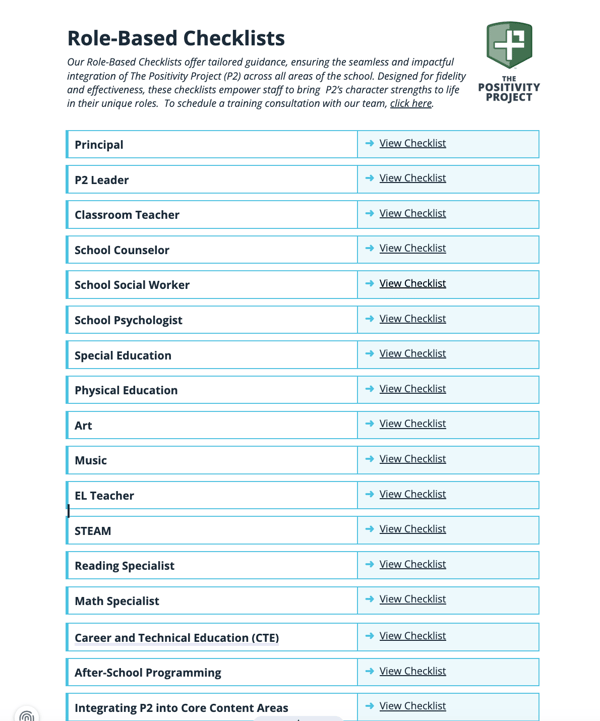
No specialist is required at any level. The daily lesson is taught by the teacher who already has those students — and P2 publishes role-based checklists for 17 staff roles, from school counselors and special education to art, music, PE, CTE, and after-school programming. Everyone in the school can use P2 to build stronger connections with students.

How P2 grows by grade

P2 grows with students from Pre-K through 12th grade. The same character strengths are taught the same week in every school, with different daily lessons for every grade level.

Grades Pre-K - 5

Elementary School

Where P2 runs:
Morning meeting

How often:
5 days a week

How long:
10 to 15 minutes

Who teaches it:
The classroom teacher

Grades 6 - 8

Middle School

Where P2 runs:
Advisory, homeroom, or subject areas

How often:
Daily, or a few days a week

How long:
10 to 15 minutes

Who teaches it:
The teacher whose period it is

Grades 9 - 12

High School

Where P2 runs:
Advisory, homeroom, or a CTE program

How often:
Once weekly, or more

How long:
30 minutes, or one 10-minute lesson

Who teaches it:
The teacher whose period it is

In every grade, students understand, explain, and apply the character strengths to build positive relationships.

In every classroom: 24 character strengths plus the five Other People Mindset elements, on one annual calendar. Tier 1 with Tier 2 and 3 support. In every building: Morning announcements, signage, assemblies, plus P2 for Families, differentiated Pre-K-K through 9-12.

Resources

Tools for planning your rollout

Decide what P2 looks like in your classrooms and schoolwide, then show each staff member what P2 looks like in their role.

Why consistency matters

Our Model

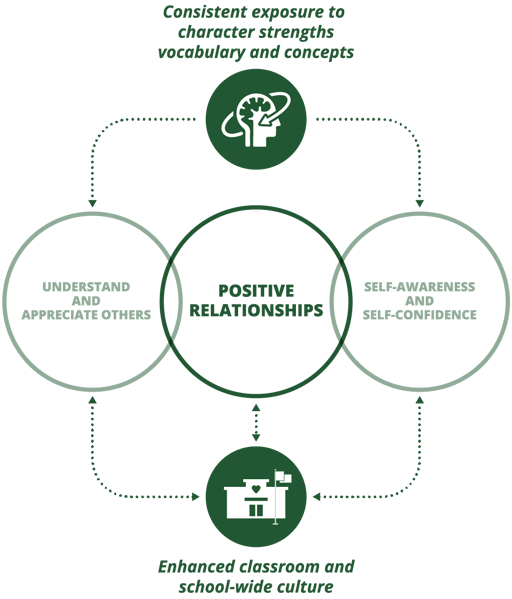
Character becomes culture through consistency

Stage 1 — Consistency

Character development starts with repeated exposure. P2 gives schools a shared annual calendar, age-appropriate lessons, and a common vocabulary so students encounter the same character strengths across classrooms and throughout the school year.

Consistency is the starting point: character can't become part of a school's culture if students only encounter it occasionally.

Stage 2 — Understand Self and Appreciate Others

As students learn the 24 character strengths, they gain language for recognizing those strengths in themselves and in other people. This builds self-awareness and helps students understand and appreciate that people bring different strengths to relationships, classrooms, and communities.

Stage 3 — Positive Relationships

Shared language becomes especially valuable in relationships. Students and adults can recognize strengths in one another, communicate more constructively, and use the same vocabulary to navigate everyday interactions and challenges.

Positive relationships are at the center of P2 because character matters most in how we treat other people.

Stage 4 — Enhanced School Culture

When that shared language and those relationship practices are reinforced across classrooms and throughout the school, they can become part of how the school operates. The result is a more positive classroom and schoolwide culture—creating stronger conditions for behavior, attendance, engagement, and learning.

Stage 1 — Consistency

Character development starts with repeated exposure. P2 gives schools a shared annual calendar, age-appropriate lessons, and a common vocabulary so students encounter the same character strengths across classrooms and throughout the school year.

Consistency is the starting point: character can't become part of a school's culture if students only encounter it occasionally.

Stage 2 — Understand Self and Appreciate Others

As students learn the 24 character strengths, they gain language for recognizing those strengths in themselves and in other people. This builds self-awareness and helps students understand and appreciate that people bring different strengths to relationships, classrooms, and communities.

Stage 3 — Positive Relationships

Shared language becomes especially valuable in relationships. Students and adults can recognize strengths in one another, communicate more constructively, and use the same vocabulary to navigate everyday interactions and challenges.

Positive relationships are at the center of P2 because character matters most in how we treat other people.

Stage 4 — Enhanced School Culture

When that shared language and those relationship practices are reinforced across classrooms and throughout the school, they can become part of how the school operates. The result is a more positive classroom and schoolwide culture—creating stronger conditions for behavior, attendance, engagement, and learning.

Stage 1 — Consistency

Character development starts with repeated exposure. P2 gives schools a shared annual calendar, age-appropriate lessons, and a common vocabulary so students encounter the same character strengths across classrooms and throughout the school year.

Consistency is the starting point: character can't become part of a school's culture if students only encounter it occasionally.

Stage 2 — Understand Self and Appreciate Others

As students learn the 24 character strengths, they gain language for recognizing those strengths in themselves and in other people. This builds self-awareness and helps students understand and appreciate that people bring different strengths to relationships, classrooms, and communities.

Stage 3 — Positive Relationships

Shared language becomes especially valuable in relationships. Students and adults can recognize strengths in one another, communicate more constructively, and use the same vocabulary to navigate everyday interactions and challenges.

Positive relationships are at the center of P2 because character matters most in how we treat other people.

Stage 4 — Enhanced School Culture

When that shared language and those relationship practices are reinforced across classrooms and throughout the school, they can become part of how the school operates. The result is a more positive classroom and schoolwide culture—creating stronger conditions for behavior, attendance, engagement, and learning.

The Positivity Project's Our Model diagram — consistent exposure to character strengths builds students' self-awareness and their understanding of others, which form positive relationships and strengthen school-wide culture, in a reinforcing loop.
Positivity-Project-Our-Model-2020_01-1


The Positivity Project teaches 24 character strengths and the five elements of the Other People Mindset, PreK–12. That consistent exposure builds students' self-awareness and their appreciation of others, which strengthens relationships, improves school culture, and creates the conditions for better behavior, attendance, and academic outcomes.

Start with one week

Every Partner School begins the same way: one character strength, the same week as more than 800 other schools, taught by the teachers already in the room.

See results from P2 Partner Schools