Multi-Tiered System of Supports
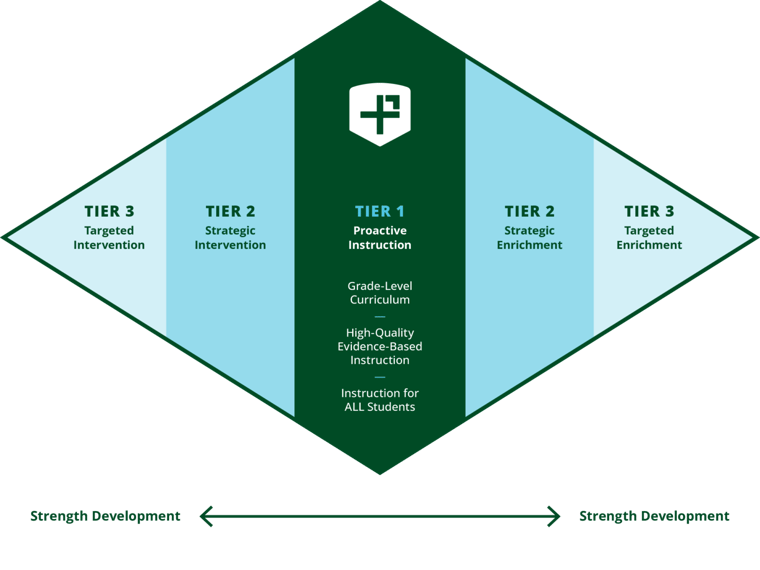
The Positivity Project (P2) offers an exceptionally strong Tier 1 solution that lays the foundation for a strong school culture. Designed to reach all students, P2 delivers consistent, proactive character education rooted in the science of positive psychology and its 24 character strengths. This universal approach doesn’t just benefit every learner — it helps to reduce the long-term need for Tier 2 and Tier 3 interventions by cultivating strong relationships, self-awareness, and a supportive school culture from the start.
Beyond Tier 1, P2 seamlessly aligns with MTSS frameworks to offer targeted intervention and enrichment as needed. For students who require additional guidance, P2 can inform strategic, character-aligned interventions at Tier 2 and provide resources for more intensive, individualized supports at Tier 3. At the same time, P2 offers enrichment opportunities that encourage all students to deepen and apply their understanding of character strengths.
With P2, schools can implement a comprehensive, strengths-based MTSS model that prioritizes prevention and long-term growth, ensuring that every student is supported in both universal and personalized ways.
The Positivity Project centers on a strengths-based philosophy that shifts the focus from what’s wrong with students – to what’s strong in students. Rather than relying solely on identifying problems, P2 equips students with the language and tools to understand themselves and others. This helps students build the resilience and positive relationships that are crucial for navigating life’s challenges.
This approach doesn’t ignore difficulties; instead, it empowers students to use their character strengths to overcome them. Through this lens, P2 redefines intervention as an opportunity to build on internal strengths, making every tier of MTSS more effective and more human-centered.
Tier 1
Promoting character strengths, and social-emotional learning (SEL) for all students.
That foster belonging and character strength development.
Tier 2
MTSS strategies like small group activities align with P2’s resources.
Advanced P2 resources deepen students’ engagement with their strengths.
Tier 3
For students with more significant needs, individualized P2-aligned interventions focus on building resilience and fostering relationships.
Offers tailored activities that help students apply strengths in meaningful, specialized ways.
Tier 1
(Proactive and preventive)
Tier 2
Tier 2
Tier 3
Tier 3 Toolkits for individual or small group interventions, coordinated with parents, and facilitated by specialized school staff.
Tier 3
See how districts use Title I, II, IV-A, and IDEA funding for P2
Instead of framing support as fixing something that’s “broken,” P2’s approach frames intervention as a means of empowering students. When students see that educators believe in their potential, it can lead to greater motivation, resilience, and a sense of self-efficacy.
P2 utilizes the strengths of students as a foundation to help them overcome adversities in their lives. This approach fosters a more optimistic and empowering environment, where students are seen as capable of growth and change, even when facing significant challenges.
P2 acknowledges that students often face significant life challenges, and instead of merely trying to alleviate these difficulties, the approach aims to help students use these experiences as stepping stones for personal growth. By connecting strengths with strategies for overcoming adversity, students can build the resilience needed to thrive both academically and personally.
Join us in building a generation of students who understand the power of character and relationships. Whether you’re an educator, parent, or community leader, you can help bring The Positivity Project to your school and make a lasting impact on students’ lives.
P2 is designed primarily as a Tier 1 universal intervention, delivering proactive, daily character education to every student in a school. However, P2 also supports Tier 2 through small-group activities, strategic interventions, and the Tier 2 Toolbox, and Tier 3 through individualized resources designed for use by counselors and specialized school staff. Additionally, P2 offers enrichment opportunities that encourage all students to deepen and apply their understanding of character strengths. Read about P2’s approach to MTSS.
The Positivity Project (P2) serves as the character education and SEL layer within your MTSS framework, grounded in a strengths-based approach that supports both prevention and intervention. At Tier 1, P2 builds a shared language and strong relational foundation for all students, helping to reduce the need for more intensive supports. At Tiers 2 and 3, P2 provides targeted, strengths-based resources that complement interventions—ensuring students receive consistent, aligned support within the same unified framework across all tiers.
Yes. The Positivity Project, grounded in positive psychology’s research on character and relationships, meets the criteria for a Tier 2 evidence-based intervention under the Every Student Succeeds Act (ESSA). This makes it eligible for federal funding streams that require evidence-based program status. Read the research.
Most MTSS frameworks focus on identifying and addressing problems. P2 takes a strengths-based approach — shifting the question from “what’s wrong with this student?” to “what’s strong in this student?” This reframes every tier of support as an opportunity for empowerment, which research shows leads to greater motivation, resilience, and self-efficacy.
Yes. Research published in the International Journal of Emerging Trends in Social Sciences highlights P2 as a Tier 1 program with strong potential to support students with emotional and behavioral disorders. By building positive relationships and self-awareness for all students, P2’s universal approach creates a more supportive environment for students with the highest needs. Read the research.
P2 is designed primarily as a Tier 1 universal intervention, delivering proactive, daily character education to every student in a school. However, P2 also supports Tier 2 through small-group activities, strategic interventions, and the Tier 2 Toolbox, and Tier 3 through individualized resources designed for use by counselors and specialized school staff. Additionally, P2 offers enrichment opportunities that encourage all students to deepen and apply their understanding of character strengths. Read about P2’s approach to MTSS.
The Positivity Project (P2) serves as the character education and SEL layer within your MTSS framework, grounded in a strengths-based approach that supports both prevention and intervention. At Tier 1, P2 builds a shared language and strong relational foundation for all students, helping to reduce the need for more intensive supports. At Tiers 2 and 3, P2 provides targeted, strengths-based resources that complement interventions—ensuring students receive consistent, aligned support within the same unified framework across all tiers.
Yes. The Positivity Project, grounded in positive psychology’s research on character and relationships, meets the criteria for a Tier 2 evidence-based intervention under the Every Student Succeeds Act (ESSA). This makes it eligible for federal funding streams that require evidence-based program status. Read the research.
Most MTSS frameworks focus on identifying and addressing problems. P2 takes a strengths-based approach — shifting the question from “what’s wrong with this student?” to “what’s strong in this student?” This reframes every tier of support as an opportunity for empowerment, which research shows leads to greater motivation, resilience, and self-efficacy.
Yes. Research published in the International Journal of Emerging Trends in Social Sciences highlights P2 as a Tier 1 program with strong potential to support students with emotional and behavioral disorders. By building positive relationships and self-awareness for all students, P2’s universal approach creates a more supportive environment for students with the highest needs. Read the research.
P2 is designed primarily as a Tier 1 universal intervention, delivering proactive, daily character education to every student in a school. However, P2 also supports Tier 2 through small-group activities, strategic interventions, and the Tier 2 Toolbox, and Tier 3 through individualized resources designed for use by counselors and specialized school staff. Additionally, P2 offers enrichment opportunities that encourage all students to deepen and apply their understanding of character strengths. Read about P2’s approach to MTSS.
The Positivity Project (P2) serves as the character education and SEL layer within your MTSS framework, grounded in a strengths-based approach that supports both prevention and intervention. At Tier 1, P2 builds a shared language and strong relational foundation for all students, helping to reduce the need for more intensive supports. At Tiers 2 and 3, P2 provides targeted, strengths-based resources that complement interventions—ensuring students receive consistent, aligned support within the same unified framework across all tiers.
Yes. The Positivity Project, grounded in positive psychology’s research on character and relationships, meets the criteria for a Tier 2 evidence-based intervention under the Every Student Succeeds Act (ESSA). This makes it eligible for federal funding streams that require evidence-based program status. Read the research.
Most MTSS frameworks focus on identifying and addressing problems. P2 takes a strengths-based approach — shifting the question from “what’s wrong with this student?” to “what’s strong in this student?” This reframes every tier of support as an opportunity for empowerment, which research shows leads to greater motivation, resilience, and self-efficacy.
Yes. Research published in the International Journal of Emerging Trends in Social Sciences highlights P2 as a Tier 1 program with strong potential to support students with emotional and behavioral disorders. By building positive relationships and self-awareness for all students, P2’s universal approach creates a more supportive environment for students with the highest needs. Read the research.