Alignment

The character strengths behind your portrait of a graduate

Districts put a lot of work into building their Portrait of a Graduate: a year of community input, teacher committees, board sessions, and a designer to make it look good. Then it goes on the wall in the front office and in the header of the strategic plan, and the question nobody has a clear answer to is what a teacher does with it on a Tuesday in October.

P2 is the instructional layer underneath the poster. Every attribute in a Portrait rests on character strengths that can be understood, explained, and applied, and each of those strengths has a weekly lesson behind it.

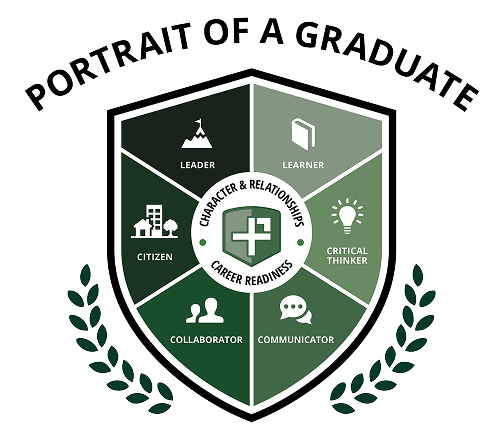
portrait-of-a-graduate shield graphic

The six attributes

P2's Portrait of a Graduate organizes the high school collection around six attributes. Underneath them sit all 24 character strengths and all five Other People Mindset elements. Every skill is named twice: the way a workplace would say it, and the character strength that supports it.

Learner

  • Appreciative Mindset (gratitude)

  • Resilience and Grit (perseverance)

  • Lifelong Learner (love of learning)

  • Appreciation of Excellence (appreciation of beauty and excellence)

  • Vision and Future Planning (purpose)

Critical Thinker

  • Exploratory Thinking (curiosity)

  • Critical Thinking (open-mindedness)

  • Contextual Understanding (perspective)

  • Innovative Thinking (creativity)

Communicator

  • Respectful Dialogue (OPM: being present)

  • Reflective Relationship Building (forgiveness)

  • Effective Communication (OPM: words and actions)

  • Social Connection (humor)

  • Engaged and Active Participation (enthusiasm)

Collaborator

  • Collaboration and Teamwork (teamwork)
  • Emotional Regulation (self-control)
  • Interpersonal Awareness (social intelligence)
  • Relationship Building (love)
  • Positive Culture Building (OPM: appreciating the good in others)


Citizen

  • Compassion and Positive Contribution (kindness)

  • Responsive Problem Solving (OPM: supporting others when they struggle)

  • Future-Focused Thinking (optimism)

  • Championing Others (OPM: cheering on others' success)

  • Civic Engagement (fairness)

Leader

  • Initiative (bravery)

  • Leadership (leadership)

  • Decision Making (integrity)

  • Self-Awareness (humility)

  • Personal Responsibility (prudence)

Learner

  • Appreciative Mindset (gratitude)

  • Resilience and Grit (perseverance)

  • Lifelong Learner (love of learning)

  • Appreciation of Excellence (appreciation of beauty and excellence)

  • Vision and Future Planning (purpose)

Critical Thinker

  • Exploratory Thinking (curiosity)

  • Critical Thinking (open-mindedness)

  • Contextual Understanding (perspective)

  • Innovative Thinking (creativity)

Communicator

  • Respectful Dialogue (OPM: being present)

  • Reflective Relationship Building (forgiveness)

  • Effective Communication (OPM: words and actions)

  • Social Connection (humor)

  • Engaged and Active Participation (enthusiasm)

Collaborator

  • Collaboration and Teamwork (teamwork)
  • Emotional Regulation (self-control)
  • Interpersonal Awareness (social intelligence)
  • Relationship Building (love)
  • Positive Culture Building (OPM: appreciating the good in others)


Citizen

  • Compassion and Positive Contribution (kindness)

  • Responsive Problem Solving (OPM: supporting others when they struggle)

  • Future-Focused Thinking (optimism)

  • Championing Others (OPM: cheering on others' success)

  • Civic Engagement (fairness)

Leader

  • Initiative (bravery)

  • Leadership (leadership)

  • Decision Making (integrity)

  • Self-Awareness (humility)

  • Personal Responsibility (prudence)

Learner

  • Appreciative Mindset (gratitude)

  • Resilience and Grit (perseverance)

  • Lifelong Learner (love of learning)

  • Appreciation of Excellence (appreciation of beauty and excellence)

  • Vision and Future Planning (purpose)

Critical Thinker

  • Exploratory Thinking (curiosity)

  • Critical Thinking (open-mindedness)

  • Contextual Understanding (perspective)

  • Innovative Thinking (creativity)

Communicator

  • Respectful Dialogue (OPM: being present)

  • Reflective Relationship Building (forgiveness)

  • Effective Communication (OPM: words and actions)

  • Social Connection (humor)

  • Engaged and Active Participation (enthusiasm)

Collaborator

  • Collaboration and Teamwork (teamwork)
  • Emotional Regulation (self-control)
  • Interpersonal Awareness (social intelligence)
  • Relationship Building (love)
  • Positive Culture Building (OPM: appreciating the good in others)


Citizen

  • Compassion and Positive Contribution (kindness)

  • Responsive Problem Solving (OPM: supporting others when they struggle)

  • Future-Focused Thinking (optimism)

  • Championing Others (OPM: cheering on others' success)

  • Civic Engagement (fairness)

Leader

  • Initiative (bravery)

  • Leadership (leadership)

  • Decision Making (integrity)

  • Self-Awareness (humility)

  • Personal Responsibility (prudence)

exploratory thinking slide deck image

What a lesson looks like

Every lesson is a slide deck a teacher opens and teaches. It defines the attribute, connects it to the character strength underneath, and then gives three components of about 10 minutes each: a discussion, an activity, and a career readiness activity. A school can choose to teach one, two, or all three depending on whether they have a ten minute block in a class, twenty minutes throughout the week, or a thirty minute advisory block.

Three ways into the same resources

Every high school runs differently, and the goal a school is trying to achieve should shape how it uses P2. There are three entry points, drawing on the same lessons, organized three ways.

calendar-green

P2 High School Calendar

The new High School Calendar intentionally follows the same week-by-week sequence as P2's nationwide Pre-K–12 calendar, so a senior and a second grader discuss the same strength in the same week. Each week pairs a Portrait of a Graduate attribute with its character strength or Other People Mindset element. Curiosity on the nationwide calendar becomes Exploratory Thinking (Curiosity) at the high school level. Districts already running P2 are not starting over. They are adding a high-school-ready layer to a foundation students have had for years.

Best for: districts that want one shared sequence across every grade band.

camera-green

P2 Portrait of a Graduate

The same lessons, reorganized by the six attributes: Learner, Critical Thinker, Communicator, Collaborator, Citizen, and Leader. Each is mapped to the character strengths and Other People Mindset elements underneath it, so a school chooses which attributes to emphasize and in what order.

Best for: schools and districts that lead with their own Portrait of a Graduate.

tool-green

P2 Career Readiness Toolbox

The career side of the collection is organized by workplace theme like communication, professionalism, conflict resolution, work ethic, resume writing, and interview preparation, and sequenced across grades 9–12. A ninth grader works on the first impression they make walking into an interview. By twelfth grade, they are writing the follow-up email and deciding what belongs in it.

Best for: CTE pathways, business classes, and other programs designed to strengthen life and career readiness.
Common questions about P2's Portrait of a Graduate

Do we have to use P2's six attributes?

No. The six are there for schools that want a ready-made framework. You can choose lessons and attributes that map best to your school’s goals.

Is this the same as a Portrait of a Learner?

Yes. Some states and districts use Portrait of a Learner, Profile of a Graduate, or a local variation. P2 works the same way with any of them, because the mapping happens at the level of the underlying character strengths rather than the attribute names.

Which grades does this cover?

Grades 9–12. P2's Pre-K–8 curriculum teaches the same character strengths in age-appropriate language, so a district running P2 across all grade bands is building toward its Portrait from Pre-K forward.

How does this connect to career readiness?

They draw on the same lessons, organized differently. The Portrait path organizes by attribute. The Career Readiness Toolbox organizes the same material by workplace topics.

Do we have to use P2's six attributes?

No. The six are there for schools that want a ready-made framework. You can choose lessons and attributes that map best to your school’s goals.

Is this the same as a Portrait of a Learner?

Yes. Some states and districts use Portrait of a Learner, Profile of a Graduate, or a local variation. P2 works the same way with any of them, because the mapping happens at the level of the underlying character strengths rather than the attribute names.

Which grades does this cover?

Grades 9–12. P2's Pre-K–8 curriculum teaches the same character strengths in age-appropriate language, so a district running P2 across all grade bands is building toward its Portrait from Pre-K forward.

How does this connect to career readiness?

They draw on the same lessons, organized differently. The Portrait path organizes by attribute. The Career Readiness Toolbox organizes the same material by workplace topics.

Do we have to use P2's six attributes?

No. The six are there for schools that want a ready-made framework. You can choose lessons and attributes that map best to your school’s goals.

Is this the same as a Portrait of a Learner?

Yes. Some states and districts use Portrait of a Learner, Profile of a Graduate, or a local variation. P2 works the same way with any of them, because the mapping happens at the level of the underlying character strengths rather than the attribute names.

Which grades does this cover?

Grades 9–12. P2's Pre-K–8 curriculum teaches the same character strengths in age-appropriate language, so a district running P2 across all grade bands is building toward its Portrait from Pre-K forward.

How does this connect to career readiness?

They draw on the same lessons, organized differently. The Portrait path organizes by attribute. The Career Readiness Toolbox organizes the same material by workplace topics.

Get started

P2’s Portrait of a Graduate is in the Resource Library alongside the High School Calendar and the Career Readiness Toolbox.

If you are new to P2, start with the free lessons. When you are ready to see the full collection mapped to your own Portrait, request a quote. 

Read success stories from P2 Partner high schools