Our model
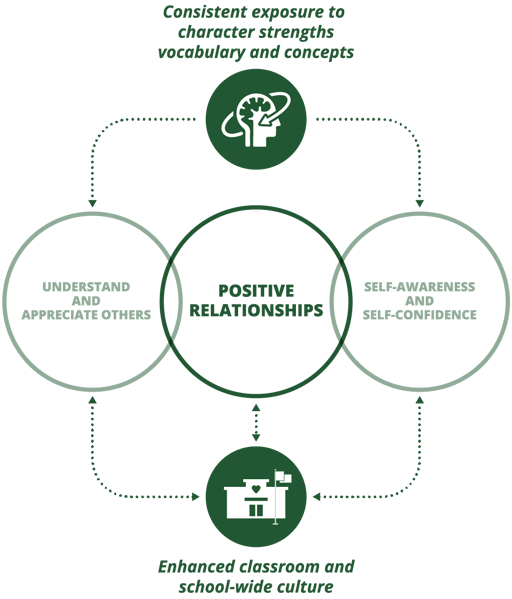
The Positivity Project teaches 24 character strengths and the five elements of the Other People Mindset, PreK–12. That consistent exposure builds students' self-awareness and their appreciation of others, which strengthens relationships, improves school culture, and creates the conditions for better behavior, attendance, and academic outcomes.
Stage 1
Every P2 Partner School teaches one character strength per week. A kindergarten teacher, a 7th grade English teacher, and an 11th grade advisory teacher, are working on curiosity at the same time, using language tailored to their students. The vocabulary and the calendar are shared across the whole district.
Elementary lessons run 10 to 15 minutes a day, five days a week, led by the classroom teacher during morning meeting. Middle schools teach that same 10-to-15-minute lesson daily or a few days a week — in advisory, homeroom, or a subject area, led by the teacher whose period it is. High schools directly teach the strength once a week or more, either a 30-minute lesson or a single 10-minute one, in advisory, homeroom, or a CTE program.
Over the course of a year, students work through all 24 character strengths from positive psychology and the five elements of the Other People Mindset on a single annual calendar. This is Tier 1 instruction reaching every student every day, with Tier 2 and Tier 3 resources for students who need more. And, the strengths shows up beyond the lesson — both inside and outside of school. This includes morning announcements, hallway signage, and assemblies — while P2 for Families carries P2 home.
Stage 2
When students consistently learn the 24 character strengths, they gain words for something they used to only feel. And those words work in two directions: self and others. A student can name perseverance in himself, which builds self-awareness and a genuine self-confidence rooted in who he is, not what he does. And he can name it in the people around him — a classmate, a teacher, a coach — which is understanding and appreciating others at the level of character. The same words let her see the character strengths of the person in the mirror and the person across the room.
Watch the video below to see how middle school students are impacted by having the vocabulary for understanding themselves and others.
Stage 3
Those two capacities work together. A student who is more self-aware — with a genuine self-confidence rooted in who she is (e.g., brave, kind, humble), not just what she does (e.g., athlete, musician, artist) — and who also understands and appreciates the people around her for who they are has what she needs to build better relationships. That combination — of self-awareness and understanding of others — provides fertile ground for a real connection with a classmate, a teacher, or a coach to grow.
The Other People Mindset makes that relationship-building work explicit. It's how P2 keeps our mission — empowering people to build positive relationships — front and center, and turns it into a daily, outward habit: identifying and appreciating the good in others, knowing that your words and actions affect others, supporting others when they struggle, cheering others' successes, and being present and giving others your attention.
Relationships are at the center of P2's model and the most rigorously studied part of it. In peer-reviewed research by Dr. Justin D. Garwood at the University of Vermont, teacher-student relationships in P2 classrooms showed higher closeness and lower conflict than in control classrooms, and students reported significant gains in their sense of relatedness.
Stage 4
When positive relationships become the norm throughout an entire building rather than in a few classrooms, the school's culture changes. Students share a vocabulary for talking about themselves and each other — and they start applying those strengths without being prompted.
Culture then feeds back into the model. A school where students feel known and understood has more room for the relationship-building, self-awareness, and appreciation of others that produced it. That is the reinforcing loop the diagram shows with bi-directional arrows at the culture node.
The outcomes below are what a positive culture makes possible, and they reflect district-wide and school-wide work on many fronts. P2 is one component of the climate and culture foundation that supports them, not a standalone driver of behavior, attendance, or academic results.
Lobbestael Elementary (MI)
Discovery Elementary (CA)
Vista Grande Elementary (CA)
In a quasi-experimental peer-reviewed study, elementary students in P2 classrooms showed significant reductions in both internalizing and externalizing behavior problems compared with a control group.
P2 grows with students from Pre-K through 12th grade. The same character strengths are taught the same week in every school, with different daily lessons for every grade level.
Grades Pre-K - 5
Where P2 runs:
Morning meeting
How often:
5 days a week
How long:
10 to 15 minutes
Who teaches it:
The classroom teacher
Grades 6 - 8
Where P2 runs:
Advisory, homeroom, or subject areas
How often:
Daily, or a few days a week
How long:
10 to 15 minutes
Who teaches it:
The teacher whose period it is
Grades 9 - 12
Where P2 runs:
Advisory, homeroom, or a CTE program
How often:
Once weekly, or more
How long:
30 minutes, or one 10-minute lesson
Who teaches it:
The teacher whose period it is
In every grade, students understand, explain, and apply the character strengths to build positive relationships.
In every classroom: 24 character strengths plus the five Other People Mindset elements, on one annual calendar. Tier 1 with Tier 2 and 3 support. In every building: Morning announcements, signage, assemblies, plus P2 for Families, differentiated Pre-K-K through 9-12.
The evidence below goes from independent peer-reviewed research down to individual school results. Peer-reviewed research provides evidence for the model, and Partner School results and videos show what P2 looks like in practice, as seen by educators on the ground.
Teachers delivered 94% of P2 lessons as written, roughly twice the rate typical of school-based character and social programs. (Peer-reviewed)
91% of educators say P2 helps students learn about themselves. (Educator survey)
P2 meets the criteria for a Tier 2 evidence-based intervention under the Every Student Succeeds Act.
In published research, P2 teachers delivered the curriculum as designed at roughly twice the rate typical of the field, and 90.9% wanted to continue using P2 the following year.
Of educators surveyed across P2 Partner Schools
Meet with our Director of Instructional Services – and get full access to every P2 lesson, PreK–12, with no commitment and no cost. See what a daily 15-minute character lesson does to the language students use about each other after a few weeks. And, if it works, we'll talk about what a full partnership looks like. If it doesn't, you've spent nothing.