Funding alignment
Every student deserves to learn how character and relationships shape a life. Budget shouldn't be the reason they don't. P2 is an ESSA Tier 2 evidence-based program, which means it qualifies for federal Title funds, IDEA, Perkins, and a growing list of state programs — and it's built as curriculum, professional learning, and family engagement, so it maps cleanly to the fund codes districts already use.
800+ Partner Schools · 400k+ Students · 50k+ Educators · 30+ States
Most federal and state funding streams require an evidence base. The Positivity Project meets the criteria for a Tier 2 evidence-based intervention under ESSA — the threshold that unlocks Title I, Title II, and Title IV spending.
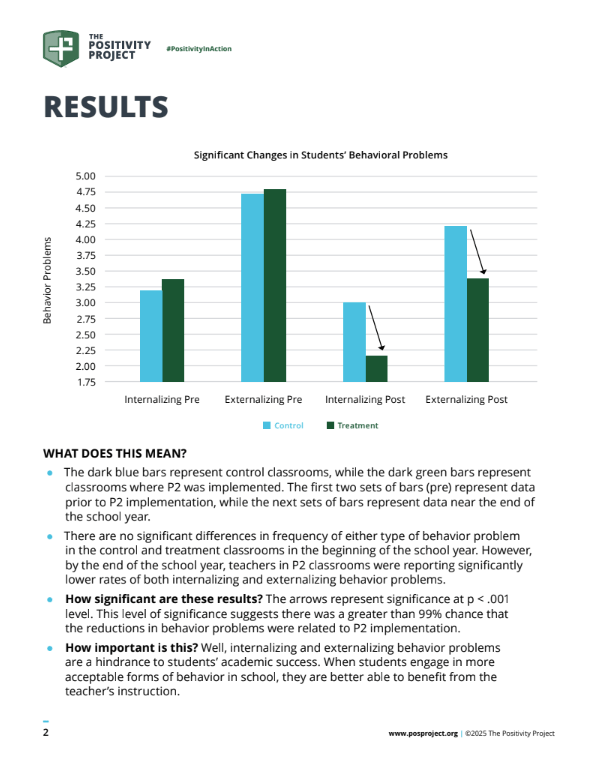
Dr. Justin D. Garwood, Professor of Education at the University of Vermont and author of more than 55 peer-reviewed articles, has studied P2's impact and found:
Significant reductions in students' internalizing and externalizing behavior problems
Improved teacher-student relationship quality — students and teachers "experienced higher rates of closeness and lower rates of conflict" compared to a control group
An enhanced sense of relatedness among P2 students
94% implementation fidelity among teachers — nearly double the rate typically seen with similar programs
That last number matters to a business office as much as the first three. Funded programs that don't get implemented don't produce outcomes, and don't survive the next budget cycle.
Before you choose a funding source, it helps to know what you're funding. Because a P2 Partnership includes three distinct components, districts can draw from multiple budget lines to cover it.
Digital resources
Fund from curriculum, instructional materials, or MTSS budgets.
Zero-prep Tier 1 daily lessons, differentiated PreK–12 — 37 weeks, 15 minutes a day
Tier 2 and Tier 3 resources for counselors and social workers supporting individual students
30+ differentiated Project Based Learning units, K–12
Middle and high school elective curriculum
P2 for Families weekly lessons and family letters — English and Spanish
Spanish-language daily lessons and character cards
Curriculum alignment documents for state requirements and academic standards
Self-Facilitated Staff Training
Fund from professional learning, Title II-A, or staff development budgets.
P2 100 Initial Implementation Training — eight modules, run in-house in 1 or 3 hours
Facilitator Guidebook, so your team leads it without outside cost
P2 for Educators and 3 Slides for staff learning across the year
Ongoing webinars and personalized support from P2's team
Optional in-person training available
Strategy + Support
Fund from school improvement, Title I schoolwide, or climate and culture budgets.
Because P2 includes curriculum, professional learning, and family engagement, districts often use more than one funding source to pay for it. That’s allowed and can make it easier to fit P2 into an existing budget.
Why P2 qualifies:
Character education and relationship-building are research-based routes to student engagement and academic achievement. P2 addresses social isolation and home-school disconnection, and builds family engagement.
What districts typically cover:
Schoolwide program costs, supplemental materials, PBIS-aligned climate resources, family engagement set-aside
Why P2 qualifies:
P2 provides training and resources that increase teacher effectiveness and help schools retain educators by improving school climate.
What districts typically cover:
The P2 100 training, ongoing professional learning, leadership support
Why P2 qualifies:
P2 builds vocabulary and communication, includes Spanish-language lessons and family materials, and increases multilingual learners' participation.
What districts typically cover:
Multilingual resources, family engagement materials, teacher training for language supports
Why P2 qualifies:
Well-rounded education, safe and healthy students, and effective use of technology — P2 hits all three of the SSAE program's content areas.
What districts typically cover:
Curriculum, social-emotional and climate programming, digital resources, out-of-school-time integration
Why P2 qualifies:
Flexible, low-infrastructure implementation makes P2 workable for rural and small districts without dedicated staff.
What districts typically cover:
Supplemental character education, professional learning, community engagement
Why P2 qualifies:
P2 supports inclusive classrooms and can be tailored to social-emotional IEP goals. A shared PreK–12 vocabulary is especially useful in special education settings, because every grade is on the same character strength each week.
What districts typically cover:
Adaptive training and resources for inclusive classroom practice
Why P2 qualifies:
Perkins V requires CTE programs to integrate academic, technical, and employability skills. P2 provides a structured, research-based framework for that third pillar, with all 24 character strengths mapped across all 16 career clusters.
What districts typically cover:
Basic and reserve allocations, when P2 is integrated as the employability skills component of a CTE program of study*
*Subject to state allowability guidelines and local Perkins application approval.
Why P2 qualifies:
Character education and relationship-building are research-based routes to student engagement and academic achievement. P2 addresses social isolation and home-school disconnection, and builds family engagement.
What districts typically cover:
Schoolwide program costs, supplemental materials, PBIS-aligned climate resources, family engagement set-aside
Why P2 qualifies:
P2 provides training and resources that increase teacher effectiveness and help schools retain educators by improving school climate.
What districts typically cover:
The P2 100 training, ongoing professional learning, leadership support
Why P2 qualifies:
P2 builds vocabulary and communication, includes Spanish-language lessons and family materials, and increases multilingual learners' participation.
What districts typically cover:
Multilingual resources, family engagement materials, teacher training for language supports
Why P2 qualifies:
Well-rounded education, safe and healthy students, and effective use of technology — P2 hits all three of the SSAE program's content areas.
What districts typically cover:
Curriculum, social-emotional and climate programming, digital resources, out-of-school-time integration
Why P2 qualifies:
Flexible, low-infrastructure implementation makes P2 workable for rural and small districts without dedicated staff.
What districts typically cover:
Supplemental character education, professional learning, community engagement
Why P2 qualifies:
P2 supports inclusive classrooms and can be tailored to social-emotional IEP goals. A shared PreK–12 vocabulary is especially useful in special education settings, because every grade is on the same character strength each week.
What districts typically cover:
Adaptive training and resources for inclusive classroom practice
Why P2 qualifies:
Perkins V requires CTE programs to integrate academic, technical, and employability skills. P2 provides a structured, research-based framework for that third pillar, with all 24 character strengths mapped across all 16 career clusters.
What districts typically cover:
Basic and reserve allocations, when P2 is integrated as the employability skills component of a CTE program of study*
*Subject to state allowability guidelines and local Perkins application approval.
Why P2 qualifies:
Character education and relationship-building are research-based routes to student engagement and academic achievement. P2 addresses social isolation and home-school disconnection, and builds family engagement.
What districts typically cover:
Schoolwide program costs, supplemental materials, PBIS-aligned climate resources, family engagement set-aside
Why P2 qualifies:
P2 provides training and resources that increase teacher effectiveness and help schools retain educators by improving school climate.
What districts typically cover:
The P2 100 training, ongoing professional learning, leadership support
Why P2 qualifies:
P2 builds vocabulary and communication, includes Spanish-language lessons and family materials, and increases multilingual learners' participation.
What districts typically cover:
Multilingual resources, family engagement materials, teacher training for language supports
Why P2 qualifies:
Well-rounded education, safe and healthy students, and effective use of technology — P2 hits all three of the SSAE program's content areas.
What districts typically cover:
Curriculum, social-emotional and climate programming, digital resources, out-of-school-time integration
Why P2 qualifies:
Flexible, low-infrastructure implementation makes P2 workable for rural and small districts without dedicated staff.
What districts typically cover:
Supplemental character education, professional learning, community engagement
Why P2 qualifies:
P2 supports inclusive classrooms and can be tailored to social-emotional IEP goals. A shared PreK–12 vocabulary is especially useful in special education settings, because every grade is on the same character strength each week.
What districts typically cover:
Adaptive training and resources for inclusive classroom practice
Why P2 qualifies:
Perkins V requires CTE programs to integrate academic, technical, and employability skills. P2 provides a structured, research-based framework for that third pillar, with all 24 character strengths mapped across all 16 career clusters.
What districts typically cover:
Basic and reserve allocations, when P2 is integrated as the employability skills component of a CTE program of study*
*Subject to state allowability guidelines and local Perkins application approval.
That gap is a budget category. P2's Career Readiness Toolbox — organized by workplace theme across grades 9–12, covering communication, professionalism, conflict resolution, work ethic, resume writing, and interview preparation — gives CTE directors and career readiness coordinators a fundable employability-skills component. Districts route it through Perkins V basic and reserve allocations, state CTE grants, and Title IV-A, in addition to the curriculum and PD funds a character education purchase normally uses.
If a principal can't find room in the character education budget, the CTE director often can.
Fill out the form and we'll send the guide that maps P2 to each federal source, with the qualifying language you can paste into a purchase justification.
In July 2026, Michigan became the first state to name character and relationship education in statute as an allowable school safety and mental health expense. The change is one sentence in Section 31aa(2)(k) of the state education budget — House Bill 5630, now Public Act 25 of 2026:
"Purchasing and implementing an evidence-based character- and relationship-building education program that includes family engagement, service learning, and project-based character development, and that fosters positive student-educator relationships and whole-school culture."
Starting with the payments that arrive December 31, Michigan districts can pay for The Positivity Project with Section 31aa money.
In July 2026, Michigan became the first state to name character and relationship education in statute as an allowable school safety and mental health expense. The change is one sentence in Section 31aa(2)(k) of the state education budget — House Bill 5630, now Public Act 25 of 2026:
"Purchasing and implementing an evidence-based character- and relationship-building education program that includes family engagement, service learning, and project-based character development, and that fosters positive student-educator relationships and whole-school culture."
Starting with the payments that arrive December 31, Michigan districts can pay for The Positivity Project with Section 31aa money.
ESSA Tier 2. Independent peer-reviewed research by Dr. Justin Garwood found reduced internalizing and externalizing behavior problems, improved teacher-student relationship quality, and 94% teacher implementation fidelity.
Daily 15-minute, teacher-led lessons on positive psychology's 24 character strengths and the Other People Mindset, in every classroom.
P2 for Families sends each week's character strength home with weekly lessons and family letters — in English and Spanish — plus a non-tech downloadable activity for each strength.
30+ differentiated PBL units spanning K–12: school-wide projects that unite grade levels in serving their school and community, and class-based units applying character strengths to real-world problems.
The peer-reviewed study Change in Teacher-Student Relationship Quality During a Tier-One Character Education Intervention found students and teachers "experienced higher rates of closeness and lower rates of conflict" versus a control group.
One shared character vocabulary, PreK–12, in every classroom and assembly — documented school by school in behavior, attendance, and belonging.
ESSA Tier 2. Independent peer-reviewed research by Dr. Justin Garwood found reduced internalizing and externalizing behavior problems, improved teacher-student relationship quality, and 94% teacher implementation fidelity.
Daily 15-minute, teacher-led lessons on positive psychology's 24 character strengths and the Other People Mindset, in every classroom.
P2 for Families sends each week's character strength home with weekly lessons and family letters — in English and Spanish — plus a non-tech downloadable activity for each strength.
30+ differentiated PBL units spanning K–12: school-wide projects that unite grade levels in serving their school and community, and class-based units applying character strengths to real-world problems.
The peer-reviewed study Change in Teacher-Student Relationship Quality During a Tier-One Character Education Intervention found students and teachers "experienced higher rates of closeness and lower rates of conflict" versus a control group.
One shared character vocabulary, PreK–12, in every classroom and assembly — documented school by school in behavior, attendance, and belonging.
ESSA Tier 2. Independent peer-reviewed research by Dr. Justin Garwood found reduced internalizing and externalizing behavior problems, improved teacher-student relationship quality, and 94% teacher implementation fidelity.
Daily 15-minute, teacher-led lessons on positive psychology's 24 character strengths and the Other People Mindset, in every classroom.
P2 for Families sends each week's character strength home with weekly lessons and family letters — in English and Spanish — plus a non-tech downloadable activity for each strength.
30+ differentiated PBL units spanning K–12: school-wide projects that unite grade levels in serving their school and community, and class-based units applying character strengths to real-world problems.
The peer-reviewed study Change in Teacher-Student Relationship Quality During a Tier-One Character Education Intervention found students and teachers "experienced higher rates of closeness and lower rates of conflict" versus a control group.
One shared character vocabulary, PreK–12, in every classroom and assembly — documented school by school in behavior, attendance, and belonging.
If your district wants help claiming these funds — whether or not you ever partner with P2 — we will walk your business office through the opt-in step by step.
P2 is implemented in 800+ schools across more than 20 states, and every state has its own routes. Below are the sources we see most often. If your state isn't listed, your state Department of Education or intermediate/county education agency is the right first call — ask specifically about school climate, mental health, expanded learning, and school improvement funds.

P2 aligns with the California Community Schools Partnership Program (CCSPP), the Expanded Learning Opportunities Program (ELO-P), Comprehensive Support and Improvement (CSI), the After School Education and Safety program (ASES), and 21st Century Community Learning Centers. P2's daily lessons run inside the school day; the same materials extend into expanded learning, summer programs, and family engagement.
Most California districts fund P2 through their LCAP. It fits the climate, student engagement, and connectedness goals districts are already writing — which makes it sustainable year over year rather than dependent on a grant cycle.

Texas law requires every district and charter to adopt a character education program covering ten named traits, with instruction in each of four grade bands. Districts fund it through the Instructional Materials and Technology Allotment — $174.69 per student in formula money, no application — and through the School Safety Allotment, raised in 2025 to $33,540 per campus plus $21.10 per student in ADA.

Florida requires five hours of resiliency education each year in grades 6–12, and requires districts to file a plan with the state every July 1 naming the materials they use to deliver it. P2 publishes a full alignment to all twelve Florida Resiliency Characteristics.

Pennsylvania made $140 million available in 2026–27 for school safety, security, and mental health — the largest single-year state investment of its kind. The core $138 million School Safety and Mental Health Grant program is noncompetitive and formula-based: public schools receive an allocation rather than competing for one, and funds may be used for mental health initiatives and evidence-based behavioral health programs, not only physical security. A separate $20.7 million targeted program for nonpublic schools opens later in 2026. Talk to us about your PCCD allocation.

The Positivity Project supports New York State school funding through multiple mechanisms. Schools can use the following funding sources: NYS BOCES Cooperative Service Agreement (CoSer); My Brother’s Keeper (MBK) Challenge Grant Initiative; 21st Century Community Learning Centers (CCLC); School Improvement Grant (SIG); and the the 2023–2025 Recover from COVID Grant.

P2 aligns with the Extended Learning and Integrated Student Supports (ELISS) competitive grant program and 21st Century Community Learning Centers, and supports the State Board of Education's 2025–2030 strategic plan priorities around school climate, student outcomes, and educator preparedness. Cabarrus County Schools built a connected culture across 44 schools with P2.
Download this ready-to-send email template to share P2 with your leadership team.
A P2 Partnership includes 37 weeks of fully digital Tier 1 lessons differentiated PreK–12, plus middle and high school electives, Project Based Learning units, P2 for Families, and Tier 2 and Tier 3 resources for counselors and social workers. Curriculum funds are a clean fit.
A partnership includes the P2 100 video training with a facilitator's guide — everything needed to run an in-house staff training in 1 or 3 hours — plus unlimited ongoing professional learning across the year. Many Partner Districts use PD funds to cover the full cost of a partnership.
United Way, Rotary, Lions Club, Chamber of Commerce, local police and sheriff's offices — many fund school programs that reach all students. A P2 partnership is a well-defined, one-line ask with documented outcomes.
P2 is priced per school, per year. Single-year partnerships give you full access with flexibility. Multi-year agreements are available at reduced rates, and districts adopting P2 across multiple schools get custom pricing that reflects the scale of the implementation.
Whether you're a single school or a whole district, our team will build a quote against your strategic goals — and tell you which funding sources other districts in your position have used.
Yes. P2 meets the criteria for a Tier 2 evidence-based intervention under ESSA, based on independent peer-reviewed research. Tier 2 is the threshold most federal and state programs require.
Yes, and most districts do. A partnership includes curriculum, professional learning, and family engagement, so districts commonly split the cost across curriculum and PD budgets, or pair a Title fund with a state or local source. Supplement-not-supplant rules and your district's procurement process still apply.
Yes. Schools can start a free pilot and give educators full access to P2's curriculum and resources before making a partnership decision.
Yes. Multi-year agreements come at reduced rates versus single-year, and districts adopting across multiple schools get custom pricing. Schedule a consultation to talk through options.
Yes. Our team regularly helps business offices with purchase justifications, evidence documentation, W-9s and vendor setup, and — in Michigan — the Section 31aa opt-in. Contact us to inquire.
Staff-wide access to P2's full resource library — Tier 1 daily lessons, Tier 2 and Tier 3 resources, P2 for Families, Project Based Learning, electives, and P2 for Educators — plus launch training, implementation support, and ongoing coaching from P2's Implementation Team.
Yes. P2 meets the criteria for a Tier 2 evidence-based intervention under ESSA, based on independent peer-reviewed research. Tier 2 is the threshold most federal and state programs require.
Yes, and most districts do. A partnership includes curriculum, professional learning, and family engagement, so districts commonly split the cost across curriculum and PD budgets, or pair a Title fund with a state or local source. Supplement-not-supplant rules and your district's procurement process still apply.
Yes. Schools can start a free pilot and give educators full access to P2's curriculum and resources before making a partnership decision.
Yes. Multi-year agreements come at reduced rates versus single-year, and districts adopting across multiple schools get custom pricing. Schedule a consultation to talk through options.
Yes. Our team regularly helps business offices with purchase justifications, evidence documentation, W-9s and vendor setup, and — in Michigan — the Section 31aa opt-in. Contact us to inquire.
Staff-wide access to P2's full resource library — Tier 1 daily lessons, Tier 2 and Tier 3 resources, P2 for Families, Project Based Learning, electives, and P2 for Educators — plus launch training, implementation support, and ongoing coaching from P2's Implementation Team.
Yes. P2 meets the criteria for a Tier 2 evidence-based intervention under ESSA, based on independent peer-reviewed research. Tier 2 is the threshold most federal and state programs require.
Yes, and most districts do. A partnership includes curriculum, professional learning, and family engagement, so districts commonly split the cost across curriculum and PD budgets, or pair a Title fund with a state or local source. Supplement-not-supplant rules and your district's procurement process still apply.
Yes. Schools can start a free pilot and give educators full access to P2's curriculum and resources before making a partnership decision.
Yes. Multi-year agreements come at reduced rates versus single-year, and districts adopting across multiple schools get custom pricing. Schedule a consultation to talk through options.
Yes. Our team regularly helps business offices with purchase justifications, evidence documentation, W-9s and vendor setup, and — in Michigan — the Section 31aa opt-in. Contact us to inquire.
Staff-wide access to P2's full resource library — Tier 1 daily lessons, Tier 2 and Tier 3 resources, P2 for Families, Project Based Learning, electives, and P2 for Educators — plus launch training, implementation support, and ongoing coaching from P2's Implementation Team.
Curious what P2 looks like in your classrooms? Launch a free pilot and see the daily, strengths-based lessons that build belonging, improve culture, and support every student. We'll help you get started quickly and make implementation easy for your team.