Character Strengths

The 24 Character Strengths — And How to Build Them

The Positivity Project (P2) is a PreK–12 character education program built on the most extensive research effort ever undertaken to understand character: Dr. Chris Peterson and Dr. Martin Seligman’s classification of the 24 character strengths. Since 2015, P2 has helped hundreds of Partner Schools across the country teach character every day — in 15 minutes, with one vocabulary shared by kindergartners, high school seniors, teachers, and families.

This page explains what character is, why it matters, and how the 24 character strengths give schools a complete, research-based way to teach it.

Table of Contents

  1. What Is Character?
  2. Why Is Character Important?
  3. What Are Character Strengths? 
  4. Character Strengths vs. Values
  5. What Is Positive Psychology?
  6. Positive Psychology’s Six Virtues
  7. Positive Psychology’s 24 Character Strengths
  8. Definitions with Examples Of Character Strengths
  9. Character Strength Cards
  10. Why Focus on Character Strengths in School — and Why ALL 24?


What Is Character?

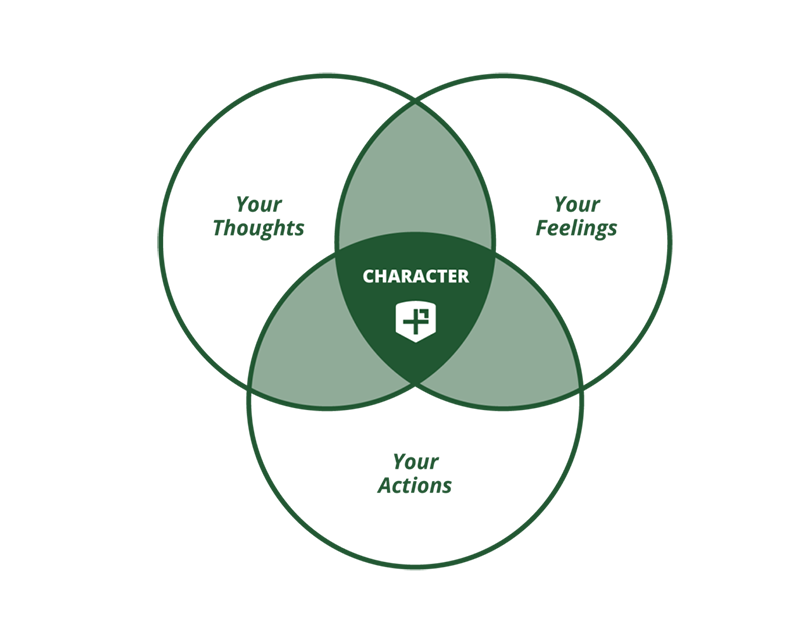
Character is how you think, feel, and act — especially toward other people.

That’s how The Positivity Project defines character. Here’s what each part means.

Venn diagram showing how thoughts, feelings, and actions overlap to create your character.

Character is more than behavior.

Dr. Chris Peterson and Dr. Martin Seligman, in their landmark 800-page classification Character Strengths and Virtues, defined character strengths as positive traits reflected in our thoughts, feelings, and behaviors. Behavior is the part the world sees — but character includes the thinking and feeling behind it. In fact, thoughts and feelings help give an action its meaning. Raising your hand while confident is participation; raising it while terrified is bravery. Giving a gift out of love is generosity; giving the same gift just to get something back is a transaction. Same actions — different character. That’s why all three belong in the definition of character. Character is the aggregate of who we are; it’s “what’s inside every one of us.”

And, your thoughts, feelings, and actions don’t have to agree for character to show up. In fact, character often shows up most clearly when they don’t. You can’t be brave without first feeling fear. You can’t show perseverance without first wanting to quit. You can’t show self-control without first being tempted to do something you shouldn’t do. The scared student who raises her hand anyway isn’t missing an ingredient of bravery — the fear is what makes it brave. And it works in the other direction, too: a kind thought that never becomes a kind act stays invisible to the person who needed it. Thoughts and feelings give an action its meaning — and the action is what makes them real.

Character is what you choose to do with what you think and feel.

That word — choose — matters. Character is not compliance. A student who behaves only when an adult is watching, or only to earn a reward, hasn’t built character; he’s learned to perform. The behavior disappears when the audience does. Real character is chosen — freely, and eventually by habit — because the student has come to see the strength as part of who he is. 

That’s why P2 doesn’t run on points, prizes, or an adult watching. Those are reactions — they show up after the behavior. P2 works proactively: 15 minutes a day, building the strengths before the hard moment arrives, so that when the test comes — the fear, the temptation, the urge to quit — the student already has something to draw on. 

P2 runs on helping students recognize the 24 strengths in themselves and in the people around them, until choosing them becomes second nature. Character strengths define who, not what, a person is — and no one can be rewarded into becoming a person of strong character.

Character shows most in how we treat other people.

Dr. Peterson spent decades researching what makes life most worth living, and he summed up the entire field of positive psychology in three words: “other people matter.” Character reveals itself in relationships — which is why P2 pairs the 24 character strengths with the Other People Mindset. The character strengths help you become your best — and positive relationships result when you’re using them.

Character is a profile, not a verdict.

Peterson and Seligman’s research shows that all 24 strengths exist in every person, in every culture, but in a different order and manner for each of us. So character education isn’t sorting students into “good character” and “bad character.” Its job is to help every student see the strengths already in them — and in the people around them.

And, character can grow.

It is not fixed at birth. This is very similar to Dr. Carol Dweck’s growth mindset: some people believe their abilities are set, while others know they can grow through effort. Character works the same way. Every time that student raises her hand while scared, the fear gets a little weaker and the strength gets a little stronger. 

Dr. Peterson explained, “Theorists as far back as Aristotle argued that virtue is the product of habitual action. One-shot positive psychology interventions can probably jump-start the process, but only sustained practice will make changes permanent.” 

That’s why P2 is built on daily practice, rather than an occasional assembly — because character develops through repetition. There is no endpoint to developing your character. It’s a lifelong endeavor for every single one of us.

Why Is Character Important?

Character is important because it’s the foundation everything else gets built on: relationships, learning, and life.

Start with relationships. Decades of research — including Harvard’s 85-year Study of Adult Development — point to the same conclusion: the quality of our relationships is the biggest predictor of long-term health and happiness. And positive relationships are built on character — on kindness, integrity, gratitude, forgiveness, and the daily choice to treat other people well.

Character shapes school culture, as well. We consistently see it in our Partner Schools. When students share a common vocabulary for character and put it into practice daily, attendance improves, behavior referrals drop, and classroom culture changes — because a strong culture allows teachers to focus on teaching and students to focus on learning.

And, character is what endures. Content knowledge gets updated. Technology gets replaced. But the strengths a student builds — perseverance when work gets hard, integrity when no one is watching, teamwork when the group is struggling — travel with them into every classroom, every job, and every relationship they’ll ever have. In a world changing this fast, character is the most durable thing a school can teach.

That’s why we treat character education as the foundation of a school — never as an extra.

See how P2 brings character education into schools →

What Are Character Strengths?

Character strengths are the ingredients of character: 24 positive traits — like bravery, kindness, perseverance, and gratitude — that exist in every person and are expressed through thoughts, feelings, and behaviors.

So, if character is how you think, feel, and act — how do you teach it? You need a common language. That’s what the 24 character strengths provide, and it’s why they’re the foundation of The Positivity Project’s model.

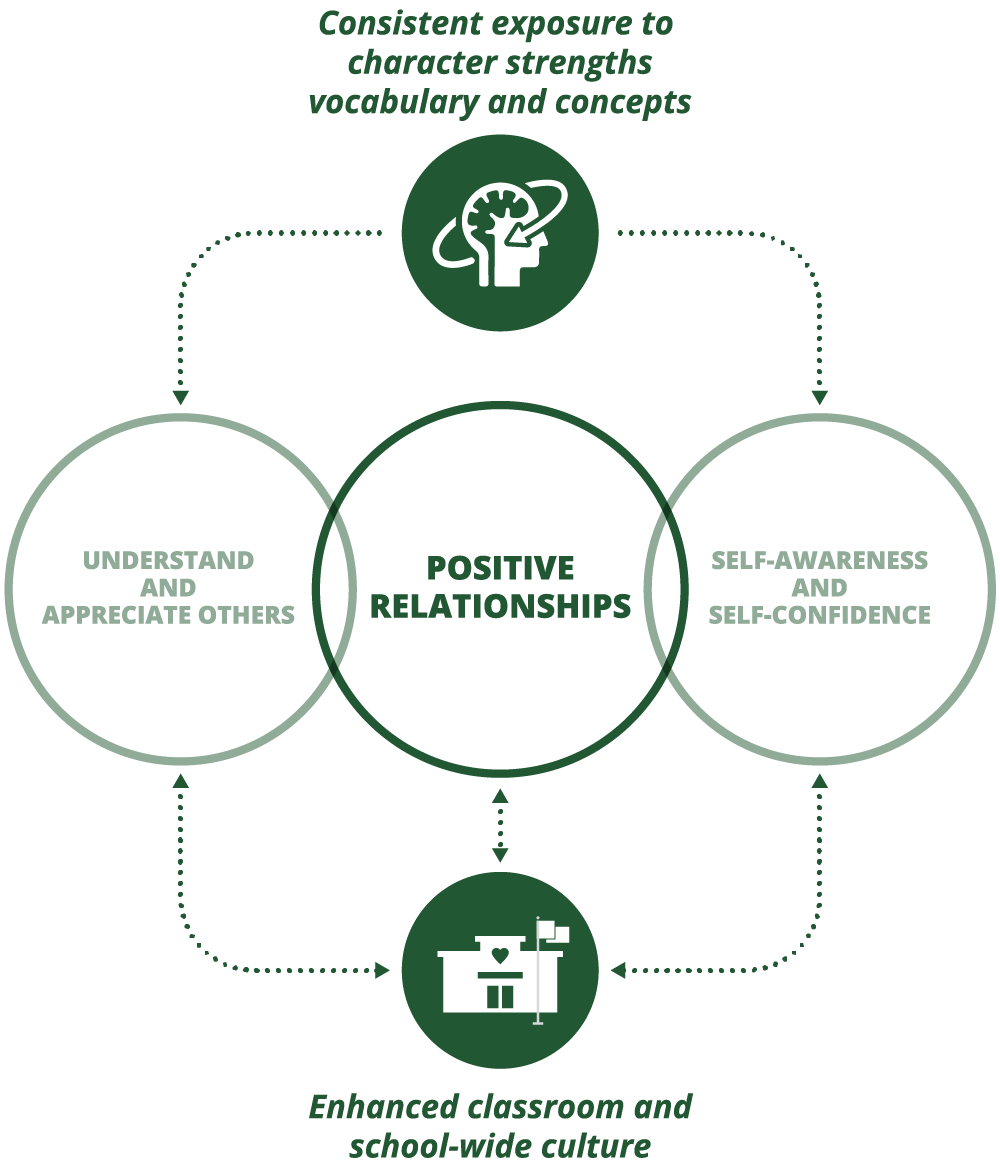
Our curriculum model shows how understanding and self-awareness come together to form positive relationships and school culture

The strengths come from the most rigorous study of character ever conducted. Dr. Chris Peterson, one of the founders of positive psychology, led a research team over a three-year period to better understand character and its manifestations. Alongside Dr. Martin Seligman, Dr. Peterson then wrote Character Strengths and Virtues. The research in this 800-page book explains:

  • The 24 character strengths that are evident in the most widely influential traditions of thought in human history.
  • The robust evidence of all 24 strengths existing throughout time and in all cultures of the world.
  • All 24 character strengths exist within — and can be used by — every individual.

Unlike our height or eye color, character strengths can’t be seen with the naked eye. Understanding and valuing them — especially in other people — requires a framework of consistent reflection and discussion. When students learn that each of them has all 24 strengths, two things happen at once: 1. They build genuine self-confidence and self-awareness; 2. They begin to understand why everyone is different — and how to appreciate those differences. That combination is what strengthens interpersonal relationships, and it pays off across a lifetime, not just a school year.

Want to know your own character strength profile? Start with The Positivity Project’s Character Strength Snapshot Survey — a quick, free look at your personal strengths. (Note: this survey has not undergone academic validation, and The Positivity Project does not collect any personally identifiable information, psychometrics, or student data through it.) For an academically validated survey, take The VIA Character Strengths Survey, initially developed under Dr. Peterson’s leadership. We encourage teachers to take it as part of their introduction to P2 — it helps you know yourself better and internalize the vocabulary you’ll use with students. Please note, The Positivity Project is not affiliated with the VIA Institute; see our VIA Survey FAQs and VIA’s privacy policy for more.

Character Strengths vs. Values

Character strengths and values are related but different: values are the destination, and character strengths are how you get there.

Character strengths are positive personality traits that reflect our basic identity — and produce positive outcomes for ourselves and others. Values are different. As Dr. Peterson explains in A Primer in Positive Psychology, “Values are beliefs held by individuals and shared by groups about desirable ends…they guide how we select actions and evaluate others and ourselves; and they are ordered by their relative importance.”

For example, the core values of the United States Military Academy at West Point are Duty, Honor, Country. Cadets use their individual character strengths — such as perseverance, teamwork, and self-control — to move toward those values. As General MacArthur explained to cadets in 1962, “Duty, honor, country: Those three hallowed words reverently dictate what you ought to be, what you can be, what you will be. They are your rallying point to build courage when courage seems to fail, to regain faith when there seems to be little cause for faith, to create hope when hope becomes forlorn.”

This distinction matters for schools. A district’s values — e.g., respect, responsibility, excellence — name where the community wants to go. The 24 character strengths give every student the tools to get there. That’s why P2 doesn’t compete with a school’s existing values; it powers schools toward them.

What Is Positive Psychology?

Positive psychology is a rigorous academic field that encompasses character strengths, positive relationships, positive experiences, and positive institutions. It is the scientific study of what makes life most worth living — and maintains that what is good in life is as genuine as what is bad.

Although positive psychology focuses on what goes right in life, it doesn’t ignore what goes wrong. As Drs. Peterson and Seligman wrote in Character Strengths and Virtues, “There is a temptation to regard positive psychology as focusing on the stress-free individual, but this is a mistake… In accentuating the positive, we cannot ignore the negative. Conditions of adversity, whether external or internal, must be part of what we address in discussing character strengths.”

Positive Psychology’s Six Virtues

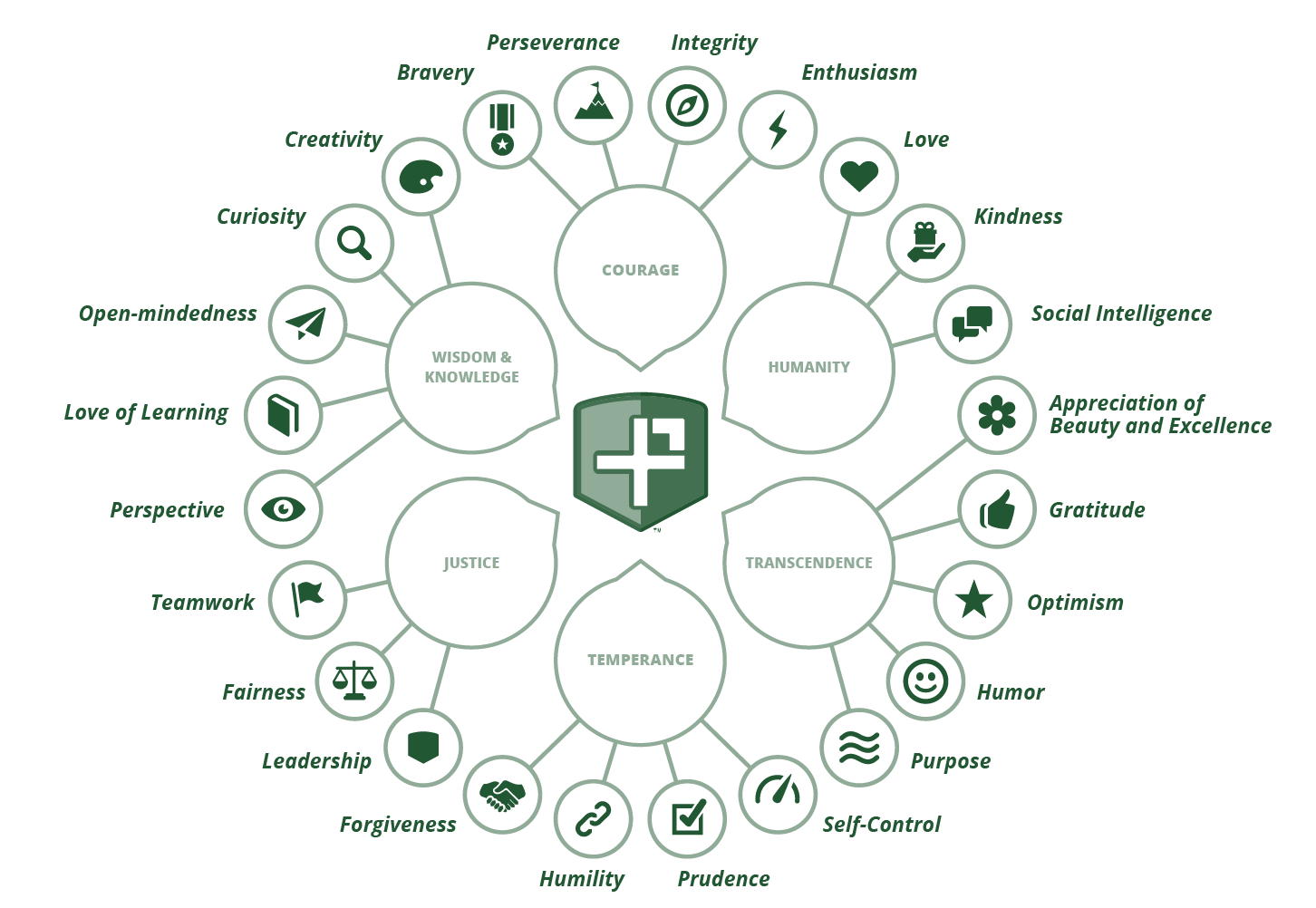
Virtues are core aspects of human excellence that allow us to survive and thrive. Researchers found six core virtues to be ubiquitous across cultures. The 24 character strengths are organized under the six virtues of: wisdom and knowledge; humanity; justice; courage; temperance; and transcendence.


  • Wisdom and Knowledge – Strengths of wisdom and knowledge are cognitive strengths related to the acquisition and use of information. Strengths comprised in this virtue are creativity, curiosity, open-mindedness, love of learning, and perspective.
  • Humanity Strengths of humanity involve caring interpersonal relationships with others, particularly in one-to-one relationships. Strengths comprised in this virtue are love, kindness, and social intelligence.
  • Justice Strengths of justice refer to the optimal relationship between the individual and the group or community, rather than the more one-to-one relationships in the humanity virtue. Strengths comprised in this virtue are teamwork, fairness, and leadership.
  • Courage – Strengths of courage involve applying will and fortitude in overcoming internal or external resistance to accomplish goals. Strengths comprised in this virtue are bravery, perseverance, integrity, and enthusiasm.
  • Temperance – Strengths of temperance protect us from excess. Strengths comprised in this virtue are forgiveness, humility, prudence, and self-control.
  • Transcendence – Strengths of transcendence allow people to rise above their troubles and find meaning in the larger universe. Strengths of transcendence are appreciation of beauty and excellence, purpose, gratitude, optimism, and humor.
Positive Psychology’s 24 Character Strengths

positive psychology's 24 character strengths - The Positivity Project

Character Strengths in the Classroom

Knowing the 24 character strengths is a start. Using them with students is where the real work, and the real results, happen. Here’s how P2 schools put character strengths to work every week:

  • Daily lessons that take 15–20 minutes, structured so any teacher can lead them without special training or prep
  • Grade-level surveys so students identify their own top strengths
  • The Other People Mindset: a core P2 practice where students learn to spot character strengths in the people around them
  • Family connection tools so character strength conversations continue at home

See how it works in your school

Character Strength Definitions


Appreciation of Beauty & Excellence
You notice and value the world’s beauty and people’s skills. You don’t take things for granted.

Overview


Bravery
You act with mental, moral, or physical strength even when you know things are difficult or scary.

Overview


Creativity
You come up with new and original ways to think about and do things.

Overview


Curiosity
You like exploration and discovery. You ask lots of questions because you want to learn more about anything and everything.

Overview


Enthusiasm
You approach life with excitement and energy. You energize people around you.

Overview


Fairness
You believe that all people have value. You approach situations with an unbiased mindset and treat everyone with respect.

Overview


Forgiveness
You let go of anger toward those who have done wrong. You accept that people make mistakes.

Overview


Gratitude
You are aware of and thankful for good things that happen.

Overview


Humility
You do not seek the spotlight. You let your actions speak for themselves.

Overview


Humor
You like to laugh and bring smiles to other people.

Overview


Integrity
Your choices reflect your values even when the choice is difficult. You are honest, keep your promises, and present yourself genuinely.

Overview


Kindness
You are generous to others and you are never too busy to help out. You enjoy doing good deeds for other people.

Overview


Leadership
You value each member of your group and inspire people to do their best.

Overview


Love
You value close relationships with others and being close to people.

Overview


Love of Learning
You master new skills and topics on your own or in school.

Overview


Open-Mindedness
You like to consider new ideas and try new things. You examine things from all sides and don’t jump to conclusions.

Overview


Optimism
You expect the best from the future and work to achieve it.

Overview


Perseverance
You complete what you start despite obstacles. You never give up.

Overview


Perspective
You appreciate that people see things in different
ways. You have the ability to understand the world
from multiple points of view.

Overview


Prudence
You plan for the future and achieve your goals by making careful everyday choices.

Overview


Purpose
You have beliefs about the meaning of life and your life’s purpose. You seek to be part of something greater than yourself.

Overview


Self-Control
You have the ability to control your emotions and behaviors. You think before you act.

Overview


Social Intelligence
You are aware of other people’s thoughts and feelings. You understand why they do things.

Overview


Teamwork
You work well as a member of a group or team. You are loyal, reliable, and dedicated to helping your team achieve its goals.

Overview

P2 Character Cards (1-Page Overviews)

Our grade 9–12 P2 Character Cards are a publicly available resource. P2 Character Cards provide a 1-page, detailed look at each character strength. These cards are available as weblinks and as PDF downloads from our searchable/sortable Resource Library. You can directly link any of these cards right into Google Classroom or send home links directly. Differentiated versions (Pre-K–2, 3–5, 6–8) are also available to Partner Schools. Many teachers use our differentiated Character Cards (regularly in the classroom), and we can’t overstate the value that we see in Partner Schools sending these home with students and parents.

Perseverance Character Card

Benefits of a Character Education Curriculum

Dr. Peterson explained that focusing on character strengths “would not only make young people happier, healthier, and more socially connected but also help them do better at school and to be more productive at their eventual work. Attention to young people’s character is not a luxury for our society but a necessity, and it requires no tradeoff with traditional academic goals.”

P2 Partner Schools consistently teach students about the character strengths that everyone possesses. This helps students become more self-aware and empathetic – leading to more positive relationships and a more positive school culture. This positive culture allows teachers to focus on teaching and students to focus on learning.

I can honestly say I have never felt so good about a character education program in my teaching career. I can actually see this program working every day. Each week that we touch on new strengths, we are all reminded of our potential to be better human beings. We have truly seen a transformation in our program since we began using The Positivity Project.

– Peggy Gordon, Educator at Loudoun County Juvenile Detention Center

Why ALL 24 Character Strengths?

Sometimes people ask, “Why are you focused on ALL 24 character strengths? Why not just 6 or 10?” That’s a good question. The answer is that The Positivity Project’s model is grounded in the research of positive psychology’s character strengths. And that research clearly shows that “All 24 Matter.” As Dr. Ryan Niemac explains, “the importance of any given strength will vary by the situation or the intended consequence…[and] how they matter will vary by person and situation.”

So, if we want students to be equipped to consciously leverage the strengths they’ll need throughout their lives in a variety of situations, they must learn about all 24. This also makes P2 more applicable to every student. Some students may identify more with optimism and enthusiasm, while others may identify more with humility and prudence. Every single one of the character strengths is important — and the 24 character strengths provide a broad common vocabulary for classrooms, schools, and districts.

As Dr. Peterson summarizes, understanding all 24 “provides a useful vocabulary for people to talk about character strengths in an appropriately nuanced way. Simply saying that someone has good character (or not) does not lead to anywhere useful. In contrast, using the strengths concepts…people can describe the profile of strengths that characterize each individual.”

Why does P2 emphasize consistency?

Our model is holistic and rooted in consistency; it incorporates and impacts students, educators, and families through regular interaction with character strengths vocabulary and concepts. Our emphasis on consistency is grounded in research from child psychology and neuroscience.

To most effectively learn a new word, concept, or skill, students should be exposed to a combination of active learning (pair-sharing, building, discussing, drawing), passive learning (listening, watching, generalizing), and settling time (walking, reflecting, sleeping, eating). It’s important to spread out the learning to maximize consolidation – the physical process of turning electrical and chemical input into a memory (Jensen, Teaching with the Brain in Mind, Revised 2nd Edition, 39-43).

This consistency is why 8th grade students at J.M. McKenney Middle School say things like, “Perseverance and Perspective have been major strengths that helped me handle social and educational challenges. Being reminded that things will pass and that I have the ability to grow and learn from them have been incredibly helpful.”

Dr. Chris Peterson explained, “Theorists as far back as Aristotle argued that virtue is the product of habitual action. One-shot positive psychology interventions can probably jump-start the process, but only sustained practice will make changes permanent.”

Are These Words “Over Students’ Heads”?

Another question people ask is, “Aren’t some of these character strengths over students’ heads?” Simply stated, they’re not. P2’s grade-level differentiated resources provide scaffolded definitions, examples, and activities to help students understand and apply character strengths in their lives.

As one English Language Learning teacher explained, “Ms. Saleh asked her students, ‘What is another character strength this person is showing?’ and the responses were incredibly intuitive! Kindergarten students were raising their hands and using the words “Integrity,” “Perseverance,” and “Gratitude”…Ms. Saleh’s students use these words with such tenacity and it seems so natural to them…If these character strengths are in their vernacular as kindergartners… imagine how their knowledge will deepen and experiences building positive relationships will flourish.”

As another teacher highlights, her students were able to use their command of character strengths to teach a local baseball coach about the concept of prudence in athletics.

Want to see how The Positivity Project would fit into your school?

Enhance your students’ relationships, behavior, and engagement in just 15 minutes a day. Our free lessons give you access to ready-to-use Tier 1 lessons aligned with your district’s character education learning goals.

Start today and see why educators love The Positivity Project.

Access free lessons