
This article was written by Sharon Batuyios, School Counselor at St. Mary Catholic School in Wilmington, North Carolina, part of the Diocese of Raleigh. Sharon teaches the P2 class described here and helped lead the school’s Positivity Project implementation for the 2025–2026 school year. St. Mary serves students from Kindergarten through 8th grade.
St. Mary Catholic School in Wilmington, North Carolina, has integrated The Positivity Project (P2) as a daily Kindergarten through 5th grade dedicated “specials” class taught by our school counselor. By utilizing P2 in this format, it becomes a weekly commitment that helps shape our Catholic school culture. This approach moves beyond the typical intermittent delivery of a character education curriculum to a more consistent, in-depth experience for our students. The lessons shape our students’ understanding of themselves and their relationships with others. We believe that character development is essential to a child’s success and well-being. P2 is central to nurturing well-rounded students who care about themselves, other people, and the world.
Integrating The Positivity Project in Our Catholic School
The Positivity Project aligns with the mission of our Catholic school by nurturing students in mind, heart, and spirit. Its focus on character strengths supports our commitment to forming students in compassion, respect, and service. By teaching children to recognize the good in themselves and others, we help them see the dignity of every person and other core Catholic values. For example, the character strengths of kindness, humility, love, forgiveness, and gratitude reinforce Gospel teachings and strengthen our school community. P2 provides practical, daily tools that empower students to live out their faith through positive relationships, intentional choices, and Christ-centered character.
Why Character Development Matters
The fundamental reason P2 matters to our school community is our conviction in the Other People Mindset (OPM), which is the project’s guiding principle. The ability to build and maintain positive relationships is a vital life skill. We recognize that academic achievement alone is insufficient for a fulfilling life. Students need self-awareness, an understanding of others, and interpersonal problem-solving skills to face challenges, demonstrate resilience, and contribute positively to society.
By prioritizing character development, we address the skills essential to overall educational success. The P2 program provides a common language for discussing complex social skills and ethical values. Students can communicate more effectively about behavior, emotions, and interactions. This shared vocabulary has improved our school climate, leading to fewer behavioral issues. Our goal is to build a more cohesive, supportive environment where students feel safe and respected. Extrinsic rewards for “good character” are finite. Our focus is on helping students internalize these strengths and experience the intrinsic reward of positive relationships and personal growth.

Adapting P2 for K–5: A Dedicated Class, Uniquely Ours
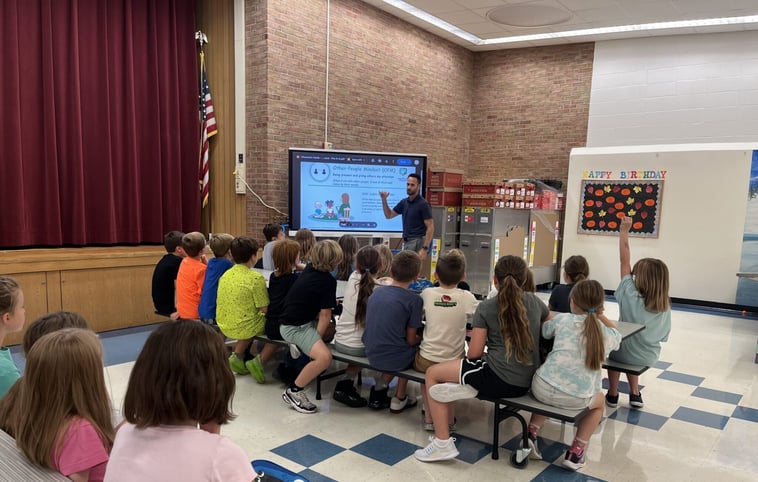
While many schools integrate P2 through short, daily morning meetings or supplementary activities, we have made the unique decision to implement P2 as a dedicated class within the daily Kindergarten to 5th grade specials rotation schedule. The school counselor teaches the differentiated P2 Daily Lessons to the developmental stages at each grade level. This structure gives every student consistent, in-depth instruction, which maximizes exposure and impact. Classroom teachers also reinforce the P2 concepts with daily lessons within their own individual classrooms. Middle school students (grades 6–8) also receive supplemental P2 daily lessons from their homeroom teachers. This helps with the following.
1. Structure and Depth of Understanding
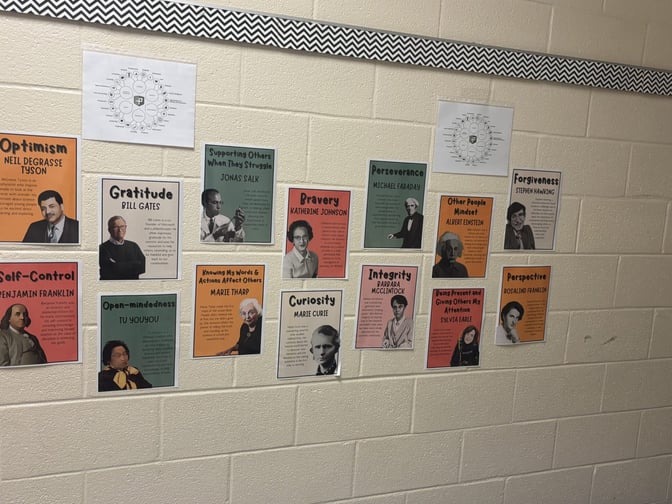
Instead of the standard 15-minute daily module, our dedicated 50-minute class allows for more in-depth exploration, discussion, and project-based learning. Each of the 24 character strengths is studied over an extended period, allowing students to move beyond simple definitions to a more meaningful understanding. The dedicated class time allows for collaboration and critical thinking, which would be difficult to squeeze into a standard 15-minute slot.
2. Cultivating Student Ownership and Agency
Our unique implementation focuses heavily on student self-reflection, collaborative learning, teamwork, and discussion. In the P2 class, students are guided to identify their own character strengths and recognize those in their peers. This strengths-based approach, grounded in positive psychology, empowers students by helping them realize they already possess the tools for success. We use the class time to facilitate discussions on how students can use their unique “superpowers” to overcome challenges.
3. Family-School Connection
In addition to our P2 class adaptation, we also connect the program to our students’ home lives. Each week, we email the P2 for Families resources, which include discussion guides, videos, and questions. The weekly newsletters help students gain a thorough grasp of the weekly strength and have meaningful conversations with their families. This consistency between school and home reinforces learning and builds a cohesive community outside of school too.

The Impact
By adapting The Positivity Project into a dedicated K–5 class in a Catholic school setting, we are cultivating students who are academically prepared and also emotionally intelligent, aware of others, spiritual, and resilient. Our students learn that character is an intrinsic part of who they are and how they connect with the world. This unique approach is building a positive school culture by blending faith, virtue, and strength of character.

Sharon Batuyios
Sharon Batuyios has spent more than 20 years in education, first in the classroom and now as a school counselor. She holds a Master of Arts in Counseling and a Bachelor of Science in Education, and she is a member of the American School Counselor Association and the North Carolina School Counselor Association. Her work centers on advocating for struggling learners and building environments where students can thrive.