This article was written by Peggy Rasheed, Dean of the Loudoun Juvenile Detention School Program in Virginia’s State Operated Programs, where she also teaches English. An Army veteran, Peggy holds a degree in secondary English education, a master’s as a Reading Specialist, and a master’s in Administration and Supervision from the University of Virginia. She has taught in juvenile detention for 27 years.
We all know that school programs come and go, sometimes from one year to the next, but with The Positivity Project (P2), we know every year we will come back to teaching our students how to explore the good in themselves to build better relationships. Before adopting P2 at in the Greenway Academy at Loudon Juvenile Detention School Program, our character education curriculum was a monthly trait that seemed to have no real context in our students’ lives. We were drawn to the philosophy of this program and its practical implications: develop these skills, become a happier person.
Why P2 Fits Our Students
Working with teenagers in a detention facility, we often see children who lack positive relationships because they have made bad choices that harmed their relationships, or they simply had no positive relationships to begin with. Many of our students are wards of the state and are missing opportunities to build relationships through family. That also means they have few role models to show them how to develop positive relationships in their lives. We see P2 as an opportunity to help students understand that they already can form good relationships. They just need to know what tools they possess and how to use them. This is my favorite aspect of the program. We can use it to help empower students to better their lives by teaching them the character strengths, why they matter, and what they can do to develop those strengths within themselves.
How Each Week Starts
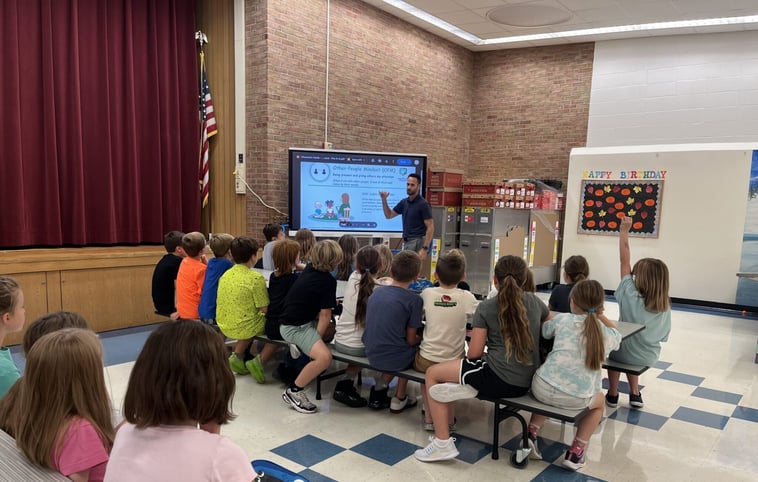
We begin each week with a new strength, and the entire school program learns about it together. My PE teacher introduces a character strength and uses the slide deck to define it and discuss it. The teachers offer insight into the strength and give examples of it in their daily lives. We ask the students to think of examples they have seen, or we use focus questions to help them develop a good understanding of what the term means. We have security personnel in our classrooms, and we invite them to contribute to the conversation as well. This is helpful because the students usually build relationships with them outside of school, and both groups get an opportunity to see what that relationship can be built on.

Character Strengths Across the School Day
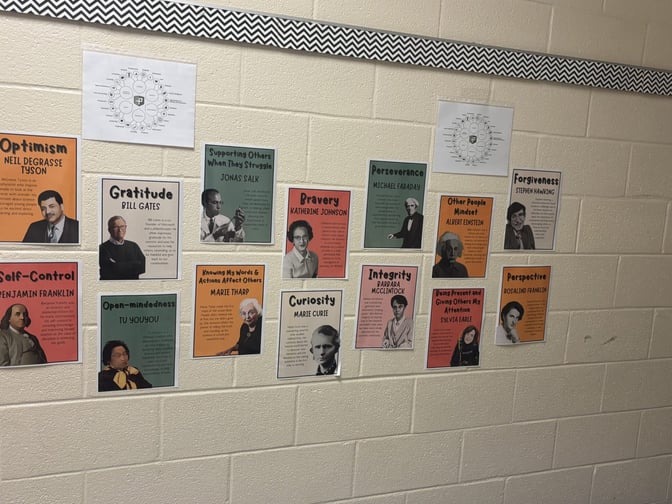
As the week progresses, we go further into the hows and whys of the character strength, using the slides in the morning to begin school. The teachers then find ways to incorporate the learning throughout the day. I find the Character Cards are a great resource for helping students understand why these strengths are important because they clearly describe why the strength matters for an individual’s growth and for group functioning. Those ideas can be extended to classroom discussions on careers, history lessons, character exploration in stories, and students’ personal lives. As the English teacher, I can often tie a character strength to something we are reading, and I use it to build journal topics for daily writing and reflection. Career exploration is an opportunity to discuss what traits make a great employee, a great boss, or a great co-worker. We have tied the strengths to student behavior and explicitly pointed out when students are demonstrating the character strengths in the classroom. In this way, they can see that they do possess these positive character strengths and can use them to build positive relationships.
Success in Greenway Academy at Loudoun Juvenile Detention School Program Requires:
Respect for Self
- Be present.
- Set goals and try to reach them.
- Ask your teacher for assistance when needed.
- Put forth total effort.
- Be willing to make mistakes and learn.
- Learn and nurture your character strengths.
Respect for Others | #OtherPeopleMatter
- Identify and appreciate the good in others,
- Know that my words and actions affect others,
- Cheer their successes,
- Be present and give others my attention
Respect for Environment
- Cultivate a positive learning environment.
- Identify and appreciate the good in others.
- Ask your teacher for assistance when needed.
- Handle materials with care (pencils, technology, etc.).
- Ask permission to leave your seat.
- Support others when they struggle.
Catching Students Being Good
It is important to “catch” students being good, to help them see when their behavior is making a positive impact. Students who are incarcerated may struggle with self-esteem and have difficulty forming good relationships. As teachers, we find any opportunity, however large or small, to help students identify positive behavior in themselves. We usually pair it with a “thank you” and a description of the positive behavior. For example, “Thank you, Jeremiah, for being honest about what happened to your book. It shows integrity, and I appreciate it.” Sometimes we might point out a positive behavior and ask, “How did that make you feel?” We want students to see the benefit of building their character in a positive, meaningful way.
What We Want Students to Take With Them
The children we see in juvenile detention are often lacking many of the skills necessary to be successful in society. We believe strongly that P2 gives us a way to teach personal accountability, positive behavior, and the skills that help students have better lives. So much of their world is chaotic and uncertain. We love showing our students that they have the power to improve their relationships and their own happiness just by consciously working on things they already possess within themselves.

Peggy Rasheed
Peggy Rasheed is Dean of the school program at the Loudoun County Juvenile Detention Center. She is also the English and resource teacher. Peggy has worked with incarcerated children for 27 years, and she loves helping the students in her care. Her philosophy is that every minute spent with a child is an opportunity to help them grow and become the best version of themselves, and no minute should be wasted. Loudoun adopted the Positivity Project (P2) in 2020 and continues to use it every year to help students better their lives. She spread the word throughout detention centers in Virginia and encourages other facilities to adopt P2 for their students.