
A District-Wide Success Story: Cabarrus County Schools

Building a Connected Culture Across 44 Schools Through The Positivity Project

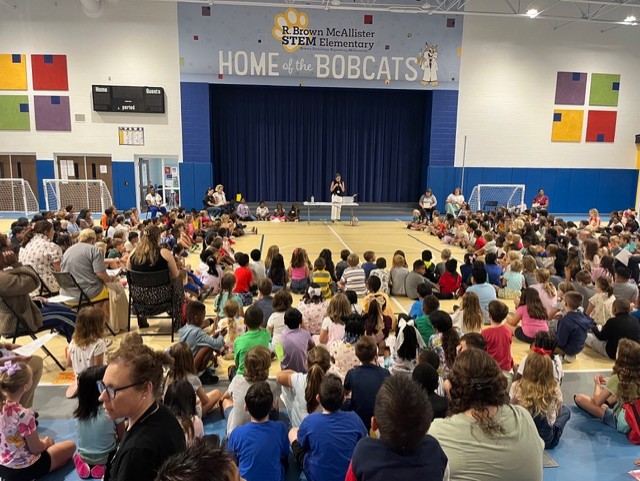
In 2022, all 44 schools in Cabarrus County Schools (CCS) — spanning Concord, Harrisburg, Kannapolis, Mt. Pleasant, and Midland — adopted The Positivity Project (P2) as the district’s core student wellness program. The goal was ambitious: give one of North Carolina’s fastest-growing districts a shared character vocabulary that could connect more than 35,000 students, anchor district-wide initiatives, and build a culture of belonging from Pre-K through 12th grade.

The result, four years in: a difference in office referrals at the school and district levels, the highest graduation rate in district history, and a chorus of educators across grade bands who say P2 has become the connective tissue that holds their initiatives — and their school cultures — together.


This is an intentional approach to connect students through character strength understanding and education, which positively impacts overall culture and climate.

Karen Hollar, Director of Student Health and Wellness, Cabarrus County Schools

The Challenge: Connecting a Growing District

By the early 2020s, Cabarrus County had become one of the fastest-growing communities in North Carolina, and CCS was scaling fast to keep up. Forty-four schools spread across five distinct municipalities each had their own identity, their own staff, and their own pace of growth. Multiple district-wide initiatives — Core Behavior Supports (CBS), Restorative Practices, Sense of Belonging Protocols, wellness screeners, school safety frameworks — were all in motion at once. Each one demanded a positive, connected school climate to succeed. Yet no single initiative could create that climate on its own.

District leaders were looking for a Tier 1 program that could do something specific: provide a shared character vocabulary and daily routine that would integrate with everything already underway, work for kindergarteners and high school seniors alike, and require almost no preparation from teachers who were already stretched thin.

The program also had to scale. With 44 schools, 4,400+ employees, and growing student enrollment, anything that demanded heavy customization at each campus would never reach fidelity. CCS needed something teacher-friendly, age-appropriate across PreK–12, and grounded in research — but flexible enough to let each school make it their own.

The Positivity Project’s strengths-based approach, daily 15-minute lesson structure, and consistent K-12 vocabulary fit the brief.

The Results

After four school years of district-wide implementation, the following outcomes have been observed across CCS schools:


Behavior & Referral Reductions

Student discipline referrals decreased district-wide during the 2024–25 school year, with individual schools reporting steeper drops. Harrisburg Elementary, for example, had a 36% decrease in overall office referrals from the 2023-2024 school year to the 2024-2025 school year after integrating P2 with their school-wide house systemIn addition, Mount Pleasant Middle School, the first middle school to receive the P2 Green Shield Award, has seen a 20% reduction in office referrals since the 2023-2024 school year.



A Common Language Across 44 Schools

Educators across CCS — from kindergarten teachers to high school principals — overwhelmingly cite “common language” as the single most valuable outcome of P2. The same character strength is taught the same week in every classroom, K-12, creating consistency that follows students through every grade and every campus.



Student-Led Leadership

Schools across the district have built P2 leadership clubs, student-led morning news segments, schoolwide service projects, and student-facilitated character lessons. Students aren’t just receiving P2 — they’re teaching it to their peers.



Integration With District Initiatives

P2 now serves as the connective thread for safety, restorative practices, behavior supports, and wellness work across all 44 schools, with a custom CCS implementation calendar, a tiered toolbox supporting MTSS, and dedicated district-level professional development through CCS’s annual RISE Conference.
Strategize With Us

Feeling inspired? Let’s talk about how your district can achieve similar results. Schedule a free consultation with our team to explore how The Positivity Project can align with your district’s goals, support your site leaders, and transform your school culture.

Speak with an Expert

Cabarrus County School District at a Glance


  • 35,000+ Students

  • 44 Schools

  • 4,400+ Staff

  • 91.7% Graduation Rate — district record, 7th of 115 NC districts on Grade Level Proficiency

  • W.R. Odell Elementary — highest elementary growth score in the state of North Carolina (2024–25)

Why CCS Chose The Positivity Project

When Cabarrus made the decision to adopt P2 district-wide in 2022, leaders weren’t looking for one more program competing for teacher time. They were looking for a foundation everything else could build on.

“By using a shared framework and common language, P2 reinforces the values we want students to develop — such as empathy, responsibility, and resilience — while ensuring consistency across classrooms and schools. This alignment strengthens implementation, supports staff in integrating SEL into daily practice, and ultimately creates a more cohesive and supportive learning environment for students.”

— Tiffany Nickel, Principal, R. Brown McAllister STEM Elementary

That alignment matters in a 44-school district. With educators speaking the same language K-12, P2 isn’t a separate initiative competing for teacher attention — it’s the through line that makes other initiatives more effective.

The breadth of buy-in tells the story. In a recent CCS educator survey, nearly 9 out of 10 respondents said they would be “very” or “somewhat” disappointed if their school could no longer use The Positivity Project — a level of educator endorsement that is rare for any district-wide program four years in.

The Implementation: District Infrastructure Meets Site-Based Personalization

CCS’s implementation balances two things that often pull against each other: tight district-wide consistency and genuine school-level autonomy.

On the district side, every CCS school works from a shared P2 implementation calendar built around the CCS academic year, so the same character strength is taught in the same week from Kindergarten to 12th grade. Karen Hollar, who leads district-wide P2 implementation, supplies each school with curated resource documents, the tiered MTSS toolbox for small-group and individual student support, an engagement toolbox for teachers, and “3-slide” mini-lessons that administrators can drop into any staff meeting. CCS’s RISE Conference brings school P2 leads together for professional learning and idea-sharing — and Karen meets directly with each school’s implementers, not just principals.

“It is incredible that the reps from P2 meet with the implementers at the school level and not just me, the district rep. We have a district of 44 schools, so the personalized support is appreciated beyond words.”

— Karen Hollar, Cabarrus County Schools

On the school side, the implementation is anything but cookie-cutter. Patriots STEM Elementary in Concord, a three-time P2 Green Shield School and a North Carolina School of Character, has built 20 minutes of “P2 time” into every student’s daily schedule. Down the road, Pitts School Road Elementary launched a student-led P2 Leadership Club. Harrisburg Elementary integrated P2 with the Ron Clark Academy House model and turned student interviews about character strengths into a weekly video series. W.R. Odell Elementary painted a P2 Character Strengths Hopscotch Board on its playground.

Green Shield Schools, Cabarrus Early College of Technology, and Mount Pleasant Middle School all build P2 into their secondary settings through community circles. At Cabarrus Early College, mixed-grade Connections groups meet for P2 lessons every Friday, fostering mentorship and giving students authentic practice in leadership, teamwork, and empathy across grade levels. At Mount Pleasant Middle, teachers use restorative circles as a proactive daily routine grounded in respect, empathy, and active listening.

P2 gives every school the same foundation and lets every school build on it differently. That’s by design.

Behavior & Referral Reductions

The most measurable outcome of P2 across CCS has been a steady, school-by-school improvement in student behavior — and the data backs it up.

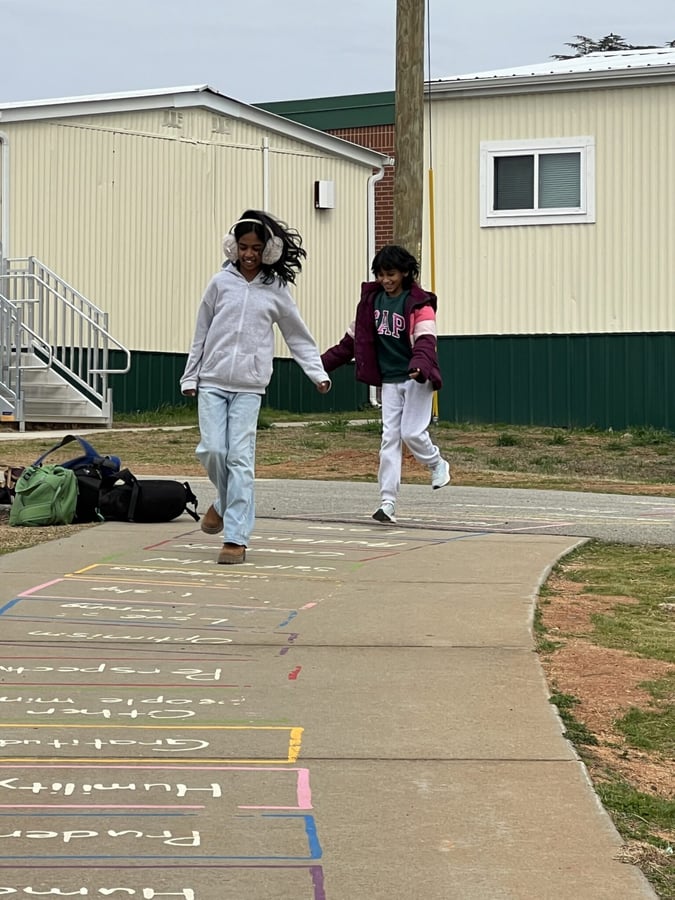
At W.R. Odell Elementary — the school with the highest elementary growth score in all of North Carolina — Principal Intern Sara Brown’s team painted a P2 Character Strengths Hopscotch Board on the playground. Students encounter strengths like kindness, teamwork, perseverance, fairness, and self-control as they play, sparking real-time conversations about how those strengths show up at recess.

w.r. odell elementary playground

This simple addition to our playground has strengthened students’ understanding of character strengths and reinforced our school’s positive culture by embedding P2 into everyday play. In the first half of the year, we reduced our playground office referrals from 36 to 21 since March of the last school year.

— Sara Brown, Principal Intern, W.R. Odell Elementary
The story repeats across the district. At Harrisburg Elementary, school counselor Sydney Riedel reports: “Student referrals have decreased, we have seen an increase in the sense of belonging over the years, and it provides us the ability to highlight students as leaders regularly. We have seen a huge increase in positive student behavior.” At Patriots STEM Elementary, Principal Amy Peters describes the outcomes simply: “Students achieve high academic results with improved engagement and behavior. Less office referrals, higher student achievement.” At CCS Opportunity School, teacher Donald Brantley reports fewer disciplinary issues since P2 adoption.

The district-level pattern Karen describes is consistent with what individual schools are seeing on the ground.

In the 2024–25 school year, we saw a decrease in referrals as the year progressed. Once P2 is established, it impacts referrals in a positive way.

— Karen Hollar, Cabarrus County Schools

During the same period, CCS posted a record 91.7% graduation rate in 2024–25 — the highest in district history — alongside its highest student proficiency levels since 2019, climbing to 7th of 115 NC districts on Grade Level Proficiency. These outcomes reflect district-wide strategic work across many fronts; P2 is one component of the climate and culture foundation that supports it, not a standalone driver of academic results.

A Common Language Across 44 Schools

Ask any CCS educator what P2 has done for their school, and the same phrase comes back: common language.

It’s the most-cited benefit in CCS’s annual P2 educator survey, named by elementary counselors and middle school principals alike. The mechanism is simple but powerful: when every classroom in every school is teaching the same character strength the same week — kindness, integrity, perseverance, gratitude — students hear those words from every adult and every peer in their orbit. Strengths stop being vocabulary words and start becoming a way of describing each other.

P2 helps create common language throughout the school and ensures alignment and focus on character strengths with students. It spurs other ways for students and staff members to look beyond superficialities and identify true positive traits we want to promote.

— Richard Wells & Connie Pilkinton, Administration, W.M. Irvin Elementary

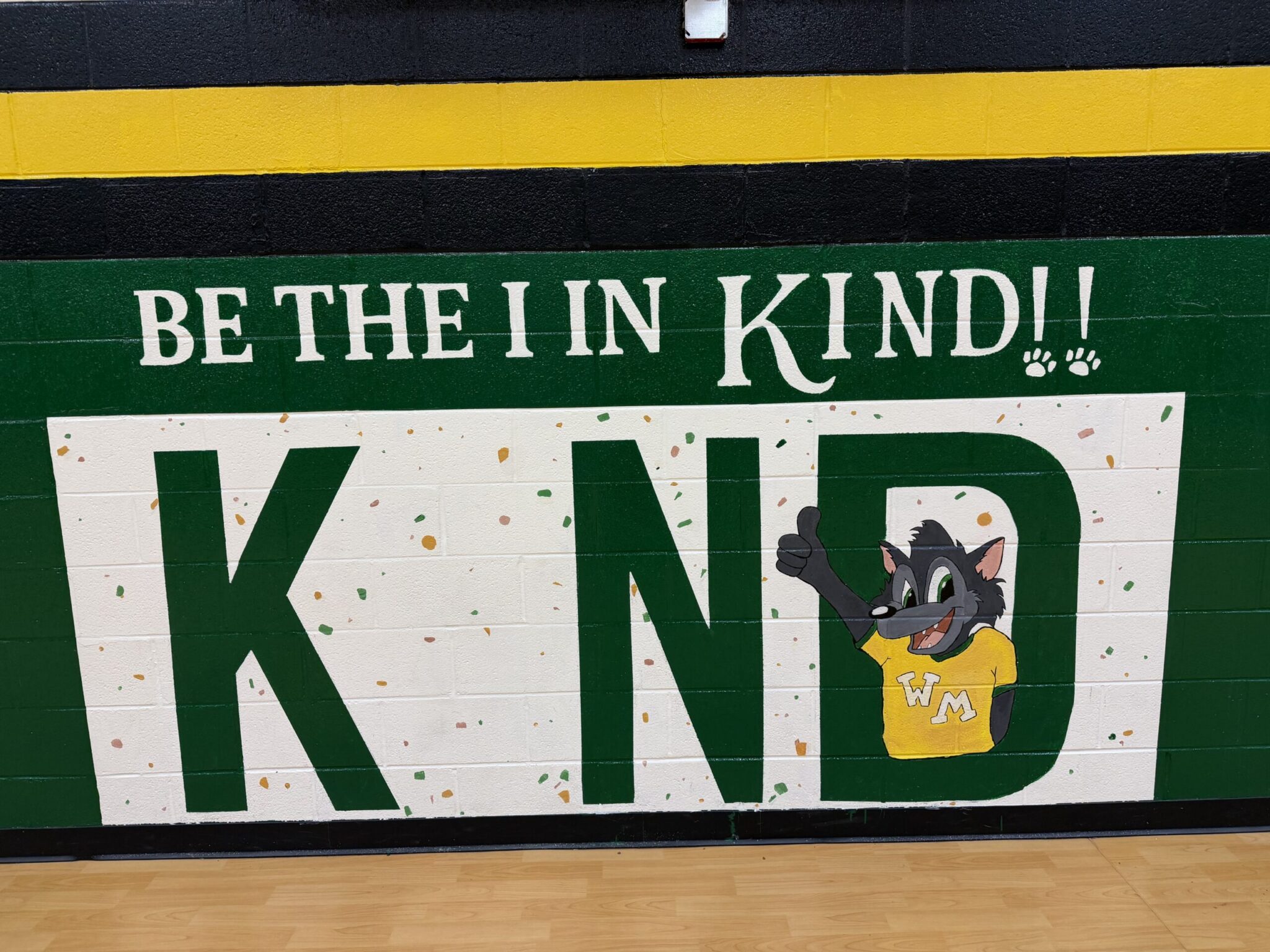
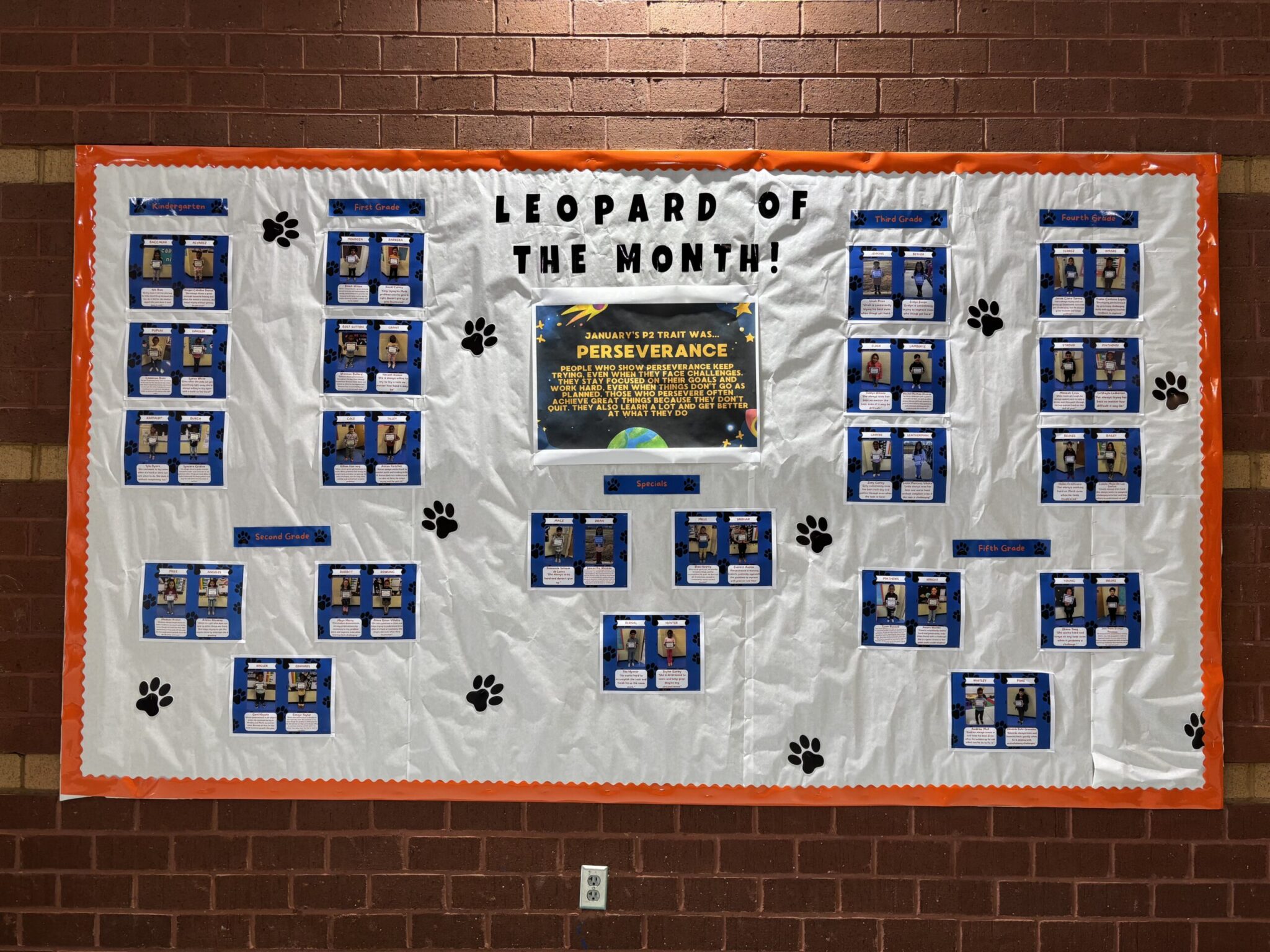
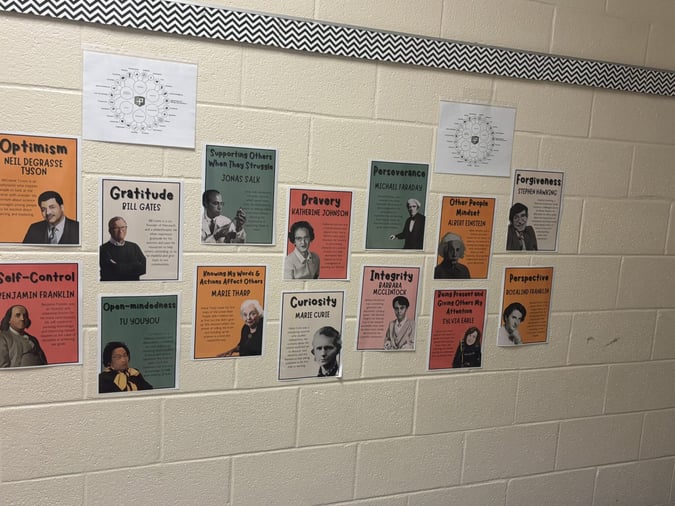
WM Irvin character education wall

In Olivia Holmberg’s 2nd grade classroom at W.M. Irvin Elementary in Concord, that consistency shows up everywhere. Her encore team has built schoolwide displays showing how musicians, artists, and scientists demonstrate P2 character strengths. Students notice strengths in read-alouds, in writing, in group work — and they’re more likely to recognize each other for them.

Instead of focusing only on rules or mistakes, we focus on strengths. When students demonstrate qualities like kindness, perseverance, self-control, or teamwork, we name it and celebrate it. This shifts the focus from what students are doing wrong to what they are doing right, helping them feel seen and valued for their character, not just their academic performance.

— Olivia Holmberg, 2nd Grade Teacher, W.M. Irvin Elementary

Holmberg recalls one moment that captures the shift: a peer publicly recognized a struggling classmate for showing bravery by speaking up in a discussion. “You could see the pride and confidence grow,” she says. “Moments like this remind me that P2 helps students see one another in a more positive and compassionate way.”

That common language extends past elementary. At Mount Pleasant Middle School, Assistant Principal Dee Smith puts it directly: “When staff speaks the same language, the students see that we are aligned in our efforts.” At Cabarrus-Kannapolis Early College High School, teacher Gerard Curtis reports that students’ “mental and emotional health has improved as they have gained vital tools from The Positivity Project to use.”

In a 44-school district, that consistency is the foundation. Without it, every other piece of the climate-and-culture work has to start from scratch every time a student changes classrooms, schools, or grade levels.

Student-Led Leadership in Action

Across CCS, P2 has stopped being something done to students and started being something done by them.

At Patriots STEM Elementary, school counselor Melissa Cahall — Cabarrus County’s 2024–25 School Counselor of the Year — built a Student Leadership Team of class presidents elected by their 3rd–5th grade peers. The team meets monthly, learns each new P2 lesson together, and then teaches it back in their own classrooms. “Students absolutely love it when their peers lead the lessons, and some classrooms are allowing students to teach P2 as a reward, further increasing engagement,” Cahall reports.

5th grade student leader

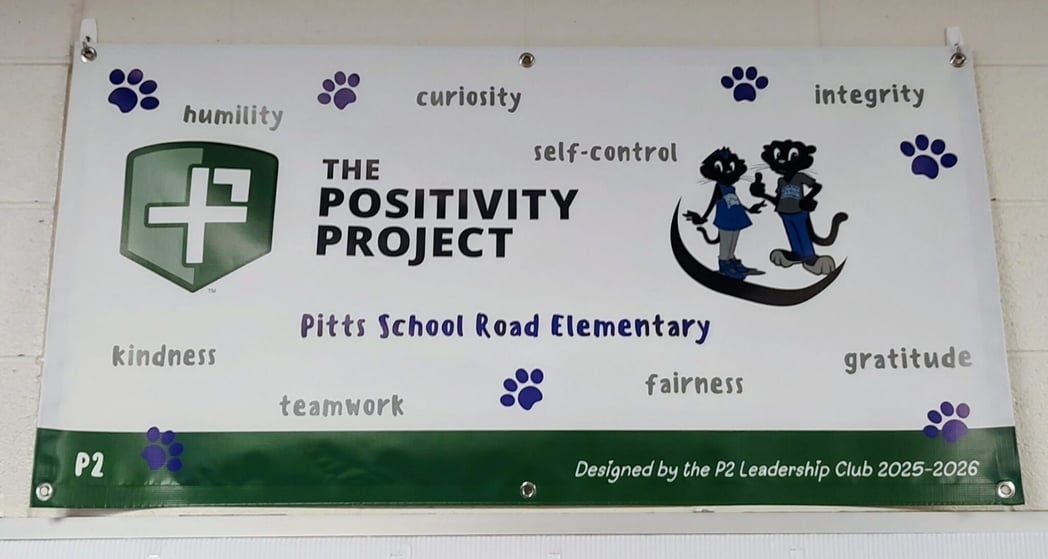
At Pitts School Road Elementary, school counselor Cassandra Bachmann launched a P2 Leadership Club for 4th and 5th graders, selected through a written application reviewed by two scorers. Club members designed a schoolwide P2 banner, organized a winter drive that collected more than 300 items for a local homeless shelter (with grade bands competing for the most donations), folded 50+ origami hearts with positive messages for nursing home residents, and even produce regular morning news videos featuring AI-generated animal characters delivering P2 strategies.

At Harrisburg Elementary, teachers Mrs. Plummer and Ms. Quigley took inspiration from a session at CCS’s RISE Conference and built a weekly Head of House (HOH)/P2 video series. Student Head of House leaders interview their peers about each week’s character strength; the videos play schoolwide and have spawned a “live event” version that the entire school now attends. “Students weren’t just watching — they were participating, discussing, and celebrating P2 in ways they never had before,” the team writes.

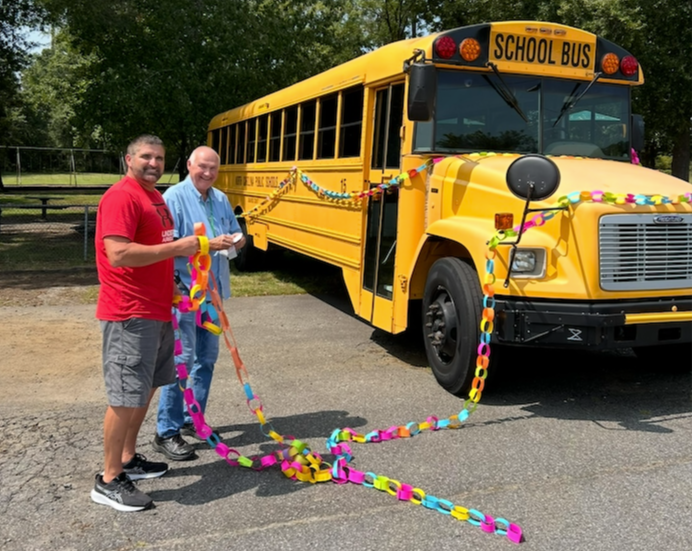
At Wolf Meadow Elementary, SEL Encore Teacher Kim Burd kicked off the school year with a Kindness Chain project. Every student wrote acts of kindness on colored paper strips; classrooms built individual chains; the combined chain wrapped around a school bus nearly two times. The students ran the project. The adults set the conditions.

kindness chain on the school bus

At Mount Pleasant Middle School, Student Government Club members are trained as P2 representatives to help teach character lessons in classrooms and serve as ambassadors for the school. What began as a student leadership group has become a group of peer educators, putting P2 in students’ hands and their voices out front.

At Cabarrus-Kannapolis Early College High School, P2 Leader Mr. Curtis has handed the program to students: every Monday, a team of P2 Student Leaders reviews the week’s character strength with him and then trains the student presenters who deliver it to their peers during Academic Learning Time. Week after week, the program starts on a positive note set in motion by students themselves.

This pattern — student leadership, student voice, student ownership — recurs at school after CCS school. It is, more than anything else, what district-wide P2 implementation has unlocked.

Integration With District Initiatives

In most districts, character education is one initiative competing with five others. In Cabarrus, it’s the connective thread for all of them.

P2 gives us an intentional resource and approach that ties together many district-wide initiatives, such as Safety, Restorative Practices, Core Behavior Supports, and Wellness Screeners. These initiatives are meant to create a positive culture and climate, and P2 gives us a resource to help bring all of that together.

— Karen Hollar, Cabarrus County Schools

The integration is deliberate and structural. CCS’s tiered P2 toolbox maps directly to the district’s Multi-Tiered System of Supports, providing classroom-wide (Tier 1), small-group (Tier 2), and individualized (Tier 3) resources for students who need additional support. Harrisburg Elementary’s monthly House meetings now incorporate Tier 2 and Tier 3 P2 resources alongside PBIS, ensuring “all students — whether they need a little extra help or are ready for more advanced challenges — have the support they need to thrive.”

The CCS implementation calendar, the RISE Conference, the engagement toolbox, the 3-slide administrator mini-lessons, and direct school visits from district leaders all turn what could be a “buy a curriculum, hand it to teachers, hope for the best” model into an ongoing, district-supported practice.

For administrators weighing the question of whether their team has time to add P2 to an already-full plate, Karen Hollar’s answer is the one CCS has lived out for four years:

Can we afford the time not to? At the heart of everything we set out to accomplish in education is building a safe and caring environment where kids and staff feel safe enough to teach and learn. P2 is the pathway to creating this environment.

— Karen Hollar, Cabarrus County Schools

A Sustainable, Scalable Culture Solution

Cabarrus County Schools’ four-year district-wide implementation of The Positivity Project demonstrates what’s possible when a sprawling, fast-growing district commits to character as the foundation under everything else. Forty-four schools — elementary through high — now share a vocabulary, a weekly rhythm, and a strengths-based approach that helps students see themselves and each other clearly. The use of Positive Office Referrals in schools is up. Graduation rates are at all-time highs. Students are leading the work.

Maybe the strongest evidence of impact comes not from a principal or a survey but from a student. At a CCS Wellness Showcase, a 2024 graduate of West Cabarrus High School stood up and spoke about what P2 had meant to her over four years:

Overall, The Positivity Project is an irreplaceable piece in my high school. It has done more good for our students than I could say here today. Even when you think a student may not be invested in The Positivity Project, I can assure you they are noticing the lessons and taking them into their own hands and implementing them into their daily lives. High school students need positivity in their life just as much as the elementary and middle school students in our county, and we can always be taught, no matter at what age, the ways in which we can improve our emotional and mental health.

— West Cabarrus High School Class of 2024 graduate

When character becomes part of the everyday language and structure of a district, the impact extends far beyond behavior or academics. It shapes a community grounded in respect, relationships, and resilience — one that students carry with them long after they leave the building.

Ready to Explore P2 for Your District?

Take the next step in empowering your staff and strengthening your school culture. Access free lessons or talk to us about your district’s goals.

Access free lessons

Contact Us