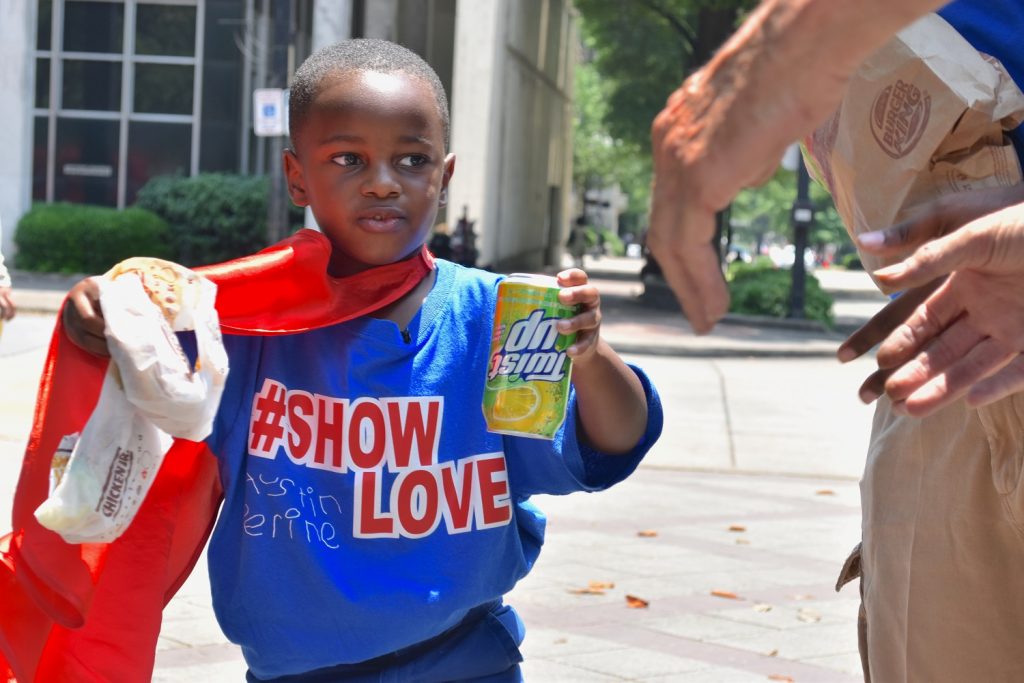
If you were homeless, would you want to be fed? Well, that’s why I’m feeding the homeless, because they’re hungry.
-Austin Perine
-
For the P2 Reflection Journals, used by all elementary students at the end of the week, click here.
Photo Credit: Karim Shamsi-Basha, Alabama Newscenter
Supporting other people when they struggle is a critical piece of being human. There is a Chinese saying that sums this up: “If you want happiness for an hour, take a nap. If you want happiness for a day, go fishing. If you want happiness for a year, inherit a fortune. If you want happiness for a lifetime, help somebody.”
There are many different approaches to helping people who are struggling. These can include: listening while they describe an event and their feelings about it, taking action to help people in need, or simply just being there and sitting together in silence. Talking through a problem is a common way to help a person who is going through a tough time. When thinking about how to help them through conversation, it can be useful to (a) validate, rather than dismissing, their feelings, (b) help them reappraise the situation, and (c) *carefully* point out logic/thinking errors that may block them from healing.
This week’s example is Austin Perine. Austin, who recently turned 5, works to feed the homeless in Birmingham, AL — and elsewhere. He delivers food and hugs with a message “don’t forget to show love.” When asked how this makes him feel, he said, “When I feed the homeless it makes me really happy and I think what I do is very special. When I grow up I want to be president. My jobs when I become president would be to feed the homeless and to chase the bad guys out of schools.”
So, why does this matter?
On an individual level, the research is clear that when we help others we also help ourselves. Dr. Roy Baumeister found that individuals who are “givers” and help other people lead more meaningful lives – with meaning defined as “a cognitive and emotional assessment of whether one’s life has purpose and value.” This goes beyond being happy in the moment and connects your past, present, and future.
On a group level, it’s critically important that we help each other out. Everyone faces tough days needs support. And, this support leads to a chain of pro-social behavior that makes us feel good about ourselves and our group. As Sebastian Junger explains in Tribe, natural catastrophes can elicit paradoxical positive emotions, because “self-interest gets subsumed into group-interest…(creating) a social bond that many people sorely miss.”

And, as a reminder, you can find all of our weekly slide presentations on our website’s Resources page here. This page is the place that we recommend you go to access all of the resources — not via Google Drive folders.
To find your grade level’s presentation, you can simply type the word “OPM2 Support Others” into the Resource Title search bar or sort by Character Strength and select OPM2 Support Others. Each of those options will provide you with 10 slide presentations. For a simple overview of the Resources page, with pictures and videos, click here.

Jeff Bryan
Jeff Bryan is the CEO and Co-Founder of The Positivity Project. In this role, he leads the organization to support educators to empower their students to build positive relationships and become their best selves.