For 25 years in Michigan schools, I lived inside the literacy block. As a teacher, an instructional coach, and then a principal, I sat through the data meetings, led and observed guided reading lessons, and experienced the pressure every elementary educator knows: reading scores are the scoreboard, and the clock is always running.
So I understand exactly why a principal looks at a character education program and asks the question directly: "Doesn't this take time away from literacy?" It's the right question.
My answer: The literacy block is protected time — as it should be — and fifteen minutes a day is real instructional time. It takes time away from literacy only if it's taught as something separate from literacy. Taught as designed, it is literacy time. The rest of this post looks at what we've seen in Partner Schools, what the research and evidence suggest, and just as importantly, what they don't.
What 340 students leaning in at the same page turn looks like
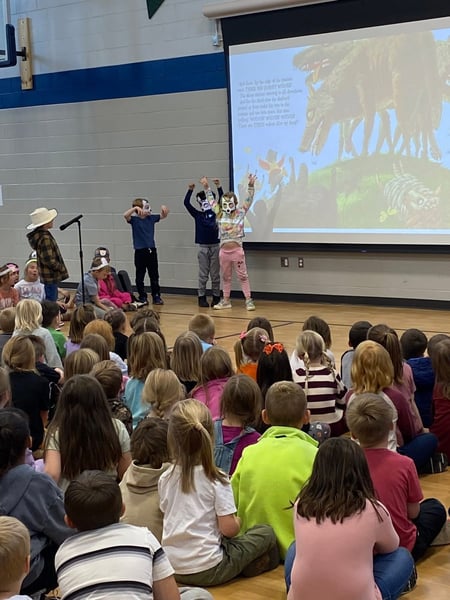
This spring, Amy Duncan, the Learning Coach at Schickler Elementary in Lapeer, Michigan, wrote about her school's Monthly Reading Assemblies — a whole-school gathering where the book is chosen to match a character strength students are learning that month. Her piece traveled further than almost anything we've published and was shared by educators across the country. I'd encourage you to read the whole thing, but here is the heart of it:
By aligning our monthly book choice with a specific character strength, like teamwork, integrity, and gratitude, we turn abstract concepts into living, breathing examples.
What struck me as a curriculum designer — and as a former principal — is that Amy's team isn't running a character activity next to their literacy work. Every one of the four outcomes she describes is a literacy outcome:
Audience skills are listening comprehension. "Eyes watching, ears listening, voices quiet, bodies calm" isn't just assembly management. Active listening — knowing when to laugh, when to hold silence, and how a group experiences a story together — is the receptive-language foundation on which classroom comprehension is built.
Social proof builds reading motivation. When students watch their principal, their teachers, and 340 peers lean in at the same suspenseful page turn, it builds “social proof” for literacy. Reading stops being a school task and becomes something their community celebrates. Motivation is the multiplier on every minute of reading instruction you deliver. You cannot phonics your way to a child wanting to read.
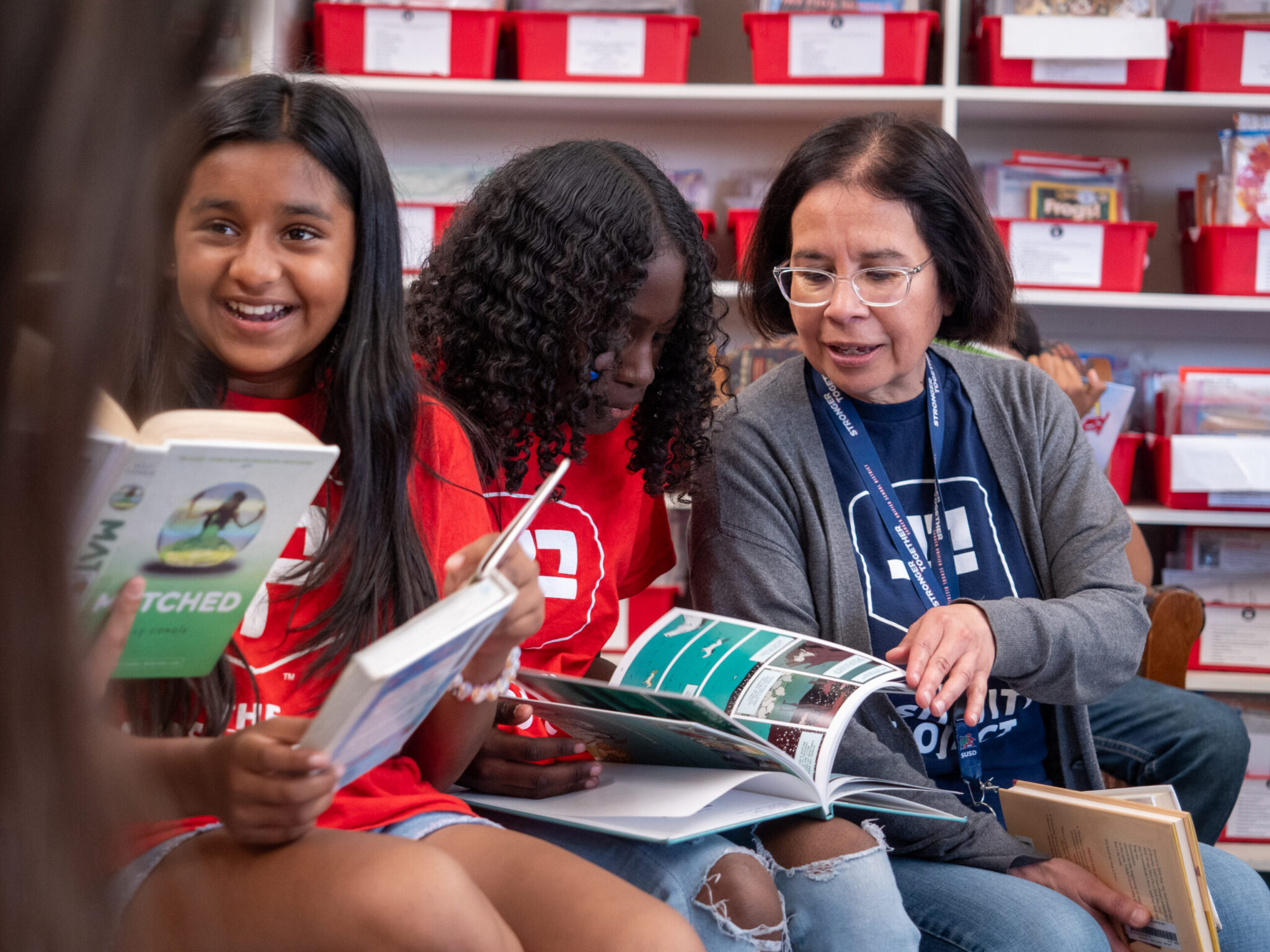
Character strengths vocabulary is academic vocabulary. Amy's team deliberately selects books rich in descriptive words that don't appear in everyday conversation but drive academic success — and anchors them in emotion and action. A student who hears the word 'resilient' while watching a character persevere doesn't just learn a definition. She gets an anchor she can retrieve. The 24 character strengths are, among other things, a 24-word Tier 2 vocabulary program: perseverance, integrity, prudence, curiosity, gratitude — taught, revisited, and used in hallway conversation all year. Visit Ms. Saleh's classroom, and you'll see what that sounds like: kindergartners — English language learners among them — raising their hands and using integrity, perseverance, and gratitude like the words have always belonged to them. If those words are in a child's vernacular at five, imagine the reader he becomes at ten.
Read-alouds model fluency. When an experienced reader changes pace to build tension, distinguishes characters by voice, and pauses for emphasis, students hear what the marks on the page are supposed to sound like. That echo follows them back to independent reading.
Stories are how character sticks — and character is why stories matter
There's a reason this integration works in both directions, and it's built into how children learn.
Abstract concepts don't hold for young learners. Integrity, as a definition, evaporates by lunch. Integrity as a character's costly choice in a story a child cares about — that stays. Narrative gives character strengths a face, a context, and an emotional anchor. This is why our Tier 1 lessons have always been built around stories: a first-grade leadership week anchors its definition in Swimmy; classrooms across the country use novels like The Wild Robot to explore empathy, curiosity, and bravery in grades 3–8 ELA.
And it runs the other way. A middle school ELA teacher at Palm Beach Maritime Academy put it plainly: using the focused character strength of the week while reading class novels made the literature more effective — students had a lens for character analysis that they carried from book to book. Ask any ELA teacher what great literature is about. It's about character. We've simply given students the vocabulary to talk about it.
It shows up in their writing, too
Reading is only half the literacy block. Listen to a third-grade teacher at one of our Partner Schools describe her realistic fiction unit — the one where students must develop a character, put that character through a conflict, and show how the character changes as a result:
"That's a pretty in-depth thing to teach a third grader. But focusing on character and different elements of character actually helped them come up with these really amazing plots — different ways the character was trying to solve those conflicts, how they felt, and how they became more empathetic or more brave in the end. I feel like this year they did the best job on their realistic fiction narratives and their character study in literature than any other year prior — because of The Positivity Project and what we're teaching them."
Think about what narrative writing demands of an eight-year-old: a believable character with an inner life, a conflict, attempts at resolution, and — the hardest part — change. That's character arc, and most third graders have no vocabulary for it. P2 students do. A child who has spent all year naming bravery, social intelligence, and perseverance in stories, in classmates, and in herself doesn't have to invent the concept of character growth from scratch. She's been studying it for 185 lessons. Her character "became more brave in the end" because the writer knows precisely what bravery is.
What's actually inside the 15 minutes
Walk through a week of P2's Tier 1 daily lessons and count the literacy practices: a story and an anchor quote to interpret on Day 1. A second text and a video to compare on Day 2. Creation — drawing or writing to translate the concept — on Day 3. Scenario analysis and structured discussion on Day 4. Reflective writing on Day 5, scaffolded with sentence starters for early learners and open journaling for older students.
That's interpreting quotes, comparing texts, speaking and listening, drawing to comprehend, and writing to reflect — every week, 185+ lessons a year, PreK–12. The 15 minutes isn't taken from literacy. It's fifteen more minutes of it, aimed at the comprehension, vocabulary, and oral language skills that reading research keeps telling us are the hard part.
What the evidence shows — and what it doesn't
I want to be honest about what these stories are. The literacy examples here — the third-grade writing unit, Ms. Saleh's kindergartners, Palm Beach Maritime's novel studies — come from teachers who saw them happen. They aren't the results of a controlled study, and the peer-reviewed research on P2 has looked at behavior, relationships, and belonging rather than reading scores. Even at Palms Elementary, where test scores rose more than 10% during a broader culture turnaround, P2 was one part of the picture, not the whole of it. Schools that do this well are usually doing a lot of things well at once.
What I feel sure of is the design itself — the interpreting, comparing, discussing, and writing that lives in every week of lessons. That's literacy work, and it holds up whether or not a study ever isolates it. It also gets taught: independent research found that teachers deliver the lessons as designed 94% of the time, because they enjoy teaching them. And the outcome teachers mention most often is a calmer classroom. After twenty-five years in elementary schools, I know where those minutes go — the time you're not spending on redirection goes back into instruction.
How to bring this to your building
Start where Schickler started: pick one book a month, align it to the strength your school is learning, and gather. You don't need a new budget line — you need a read-aloud, a gym, and adults willing to show students that stories matter here.
You don't even need to hunt for the books. Our P2 Book List is sortable by grade level and by character strength, Pre-K picture books through young-adult novels — built for exactly this kind of alignment, whether it's a monthly assembly, a mentor text for your writing unit, or a classroom read-aloud. (Some of our Partner Schools have taken it a step further with book vending machines: students spotted using a character strength earn a coin, and the coin buys a brand-new book to take home. Good character earns a good book.)
And if you want to see what the daily lessons look like in your grade level, our free lessons are ready to teach.
The literacy block and character education were never competing for the same minutes. They're reaching for the same reader: a child who has the words, the stamina, and a reason to turn the page.

Melissa Killingbeck
Melissa Killingbeck is the Curriculum Manager for The Positivity Project and ensures our resources are at their highest quality. Melissa earned her bachelor's degree and teaching certificate in elementary education and holds a Master's in Education with certification in K-12 administration. Before joining the P2 team, Melissa was a successful P2 Partner School principal in Flushing, Michigan, where she worked for 25 years as a teacher, instructional coach, and principal. After retiring from public education in 2019, Melissa relocated to northern Michigan with her husband Casey and their Silver Lab, Tank. When not knee-deep in P2 resources, Melissa can be found rockhounding along a lakeshore, enjoying a boat ride with Casey and Tank, or "downstate" visiting their two grown children.