

Inside a P2 Lesson: The Three-Phase Design That Makes 15 Minutes Enough
By Melissa KillingbeckWhen an elementary school in North Carolina set out to choose a character education program this year, their focus was on finding one with age-appropriate, relatable content that would also be easy to use and simple to implement. The principal assembled a culture committee with representation from across the building to evaluate 16 different programs. They had teachers pilot sample lessons across multiple options and collected structured feedback over a full school year.
When the dust settled, the teachers had chosen The Positivity Project.
The outcome began with a clear sense of purpose. The committee wasn’t responding to marketing materials or evidence claims. They were responding to what they experienced when they actually taught the lessons. As the principal put it, the accessibility across the board was the deciding factor: the lessons were ready to go, easy to drop into what teachers already had, and engaging enough that students leaned in.
That’s no accident. It’s the result of a deliberate design philosophy built into every P2 Tier 1 daily lesson — one that delivers meaningful, age-appropriate, and relatable impact in just 15 minutes a day, making it easy for schools to implement character education effectively and consistently.
We’re not just creating resources. We’re designing a learning experience.
The question principals actually ask
We’ve made the case before that consistency is what turns character education into culture (Why Consistency Matters), and that the underlying neuroscience favors short, varied, daily exposure over one-off interventions (Language and Consistency).
Both are true. But neither answers the question principals actually ask when they sit down to evaluate a program: Will my teachers really do this every day?
That’s a design question. And it’s the question this post answers by walking inside a single week of P2 instruction.
What a P2 Tier 1 daily lesson looks like
P2’s Tier 1 daily lessons are the universal, whole-class core of the program. Every student in a Partner School receives them. They’re delivered through Google Slides, designed to take 10–15 minutes, and require little to no prep time from teachers.
There are more than 185 lessons per grade level, spanning Pre-K through 12th grade. Each lesson is intentionally designed around a consistent flow that builds a cohesive learning experience over time. What makes the curriculum sustainable across a year, a school building, and a teacher’s career is a single, consistent architecture: Understand, Engage, Reflect. That shared architecture guides how students connect to the content, interact with it, and make it meaningful — ensuring it’s not only teachable but truly impactful.
Each week, Days 1–4 include two opportunities to build understanding and two opportunities to engage with the strength. Day 5 is for reflection.
That’s the entire week, every week, for every grade level. The architecture is the same. The content is thoughtfully designed to be age-appropriate and meet students where they are in their development.
Mel Killingbeck, P2 Curriculum Manager, walks through the structure of Tier 1 daily lessons and shares a third-grade perseverance lesson. (Click here to view a seventh-grade lesson.)
Below, we’ll go deeper into a first-grade lesson on leadership to see how the same architecture plays out at a different age and with a different strength.
Days 1–2: Understand
Day 1 begins by building meaning with the working definition: A leader inspires others to do their best. The lesson anchors that definition in a familiar story — Swimmy by Leo Lionni — and a quote from the book: “He taught them to swim together, each in his own place.” A short discussion gives the class time to recognize what leadership looks like in the story.
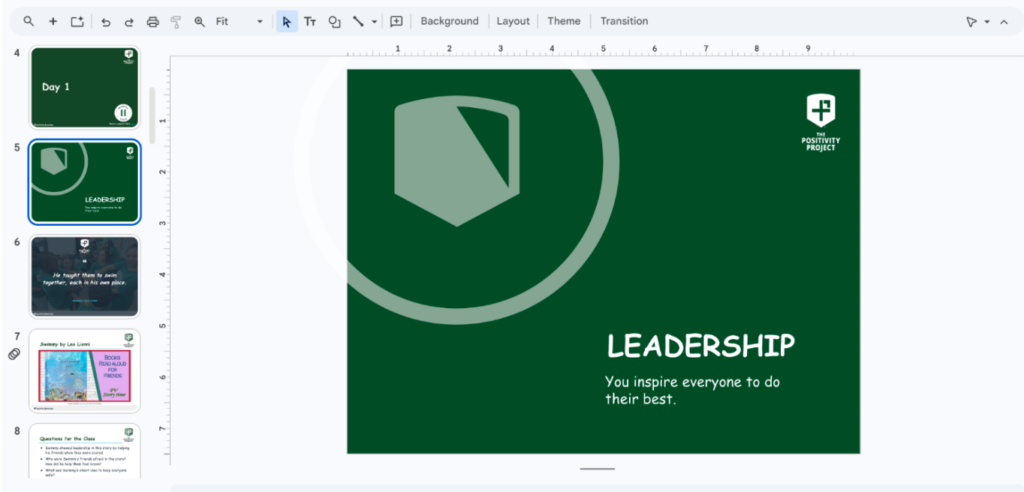
Photo of P2 Day 1 first-grade lesson slides on leadership featuring a student-friendly definition, anchor quote, and discussion prompt to help students understand and discuss the meaning of the character strength.
Day 2 reinforces the definition with a second quote — “Leadership is practice, not so much in words as in attitude and actions” — and a video clip showing leadership in action. In the case of our first-grade week, the clip is from a children’s show in which a trainer guides her young trainees through their first flight mission. Students watch her cheer for their successes, identify their strengths, and support them when they struggle. Each of those moments is also an element of the Other People Mindset — showing students that leadership isn’t a separate lesson, but something woven into everyday interactions and how we treat one another.
The cognitive focus of these first two days is intentionally simple: students learn what the character strength means and what it looks like in action. At this age, students need repetition and multiple examples to truly grasp the meaning of a character strength. Students are not yet expected to apply the skill independently—they are building a clear understanding of the concept and developing a shared language around it.
Days 3–4: Engage
This is where leadership becomes REAL –– not just something we talk about, but something they DO.
Day 3 focuses on creation and application. First graders are asked to draw a picture of someone demonstrating leadership by helping a friend, anchored in the familiar scene from Finding Nemo where Dory continues encouraging Marlin to “just keep swimming” and not give up. For young learners, drawing is more than an art activity — it’s a natural, developmentally appropriate way for them to think through ideas, make sense of new concepts, and express what they understand in ways that words alone often can’t capture. When students illustrate what leadership looks like, they move beyond simply repeating a definition and begin translating an idea into a meaningful visual representation. This process strengthens comprehension by helping students connect leadership to real actions, relationships, and experiences they can recognize.
Day 4 further engages students with the character strength through evaluation and discussion. In this example, students encounter short scenarios using familiar names. Would you follow this leader? Would you not? Rather than simply recalling the definition, students must apply what they have learned to analyze choices and actions. This is the moment when character begins to become identity. As students reflect on the actions they would choose to follow or demonstrate themselves, the character strength becomes more personal, relevant, and meaningful.
Notice what’s happened across two days: students have created with the strength, then evaluated it. Together, these two steps support deeper, more lasting learning.
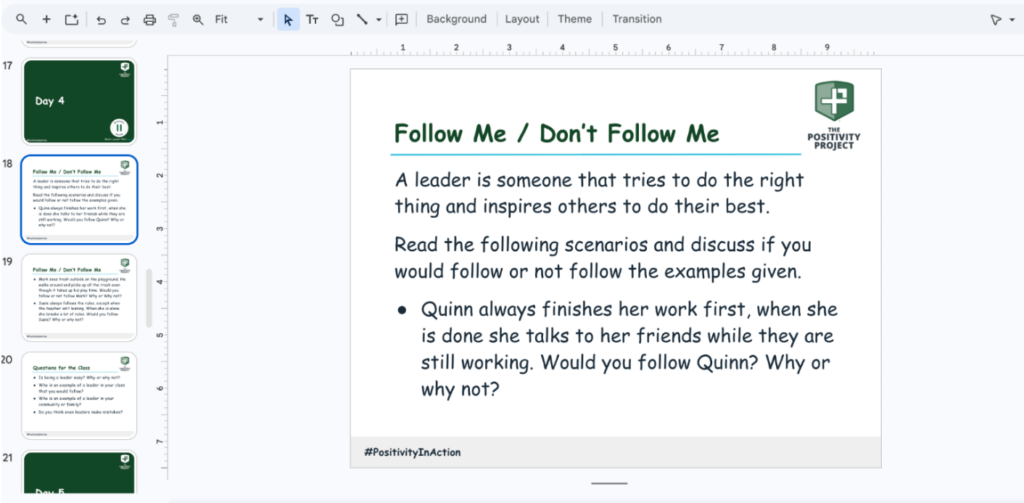
Photo of P2 Day 4 first-grade lesson slides on leadership featuring a student scenario activity and discussion prompts that help students evaluate choices and apply their understanding of the character strength.
Day 5: Reflect
Day 5 provides students with space to slow down and process what they’ve learned throughout the week. This piece is critical: reflection helps students connect the behavior to their identity as a leader. In this example, the character card for leadership serves to anchor the definition. Students then reflect on their learning through writing or drawing.
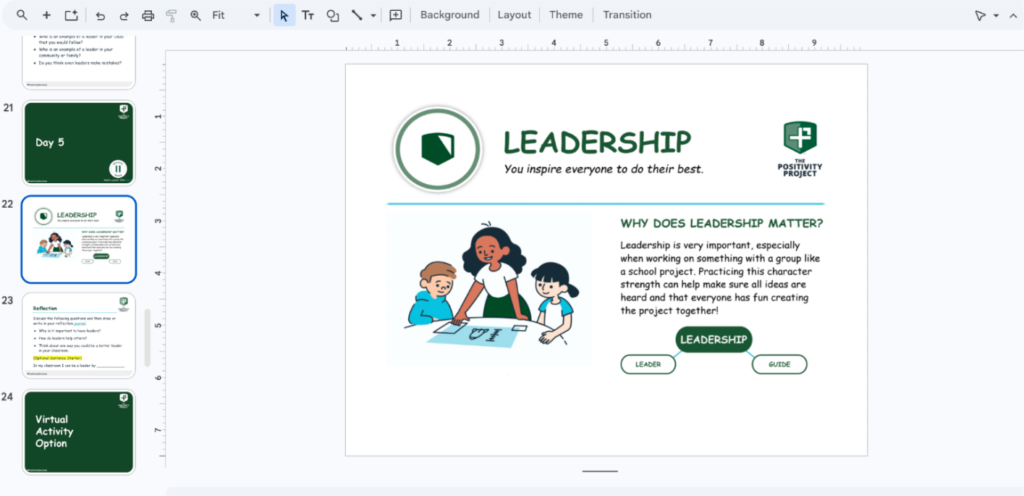
Photo of P2 Day 5 first-grade lesson slides featuring a character card review and sentence-starter reflection prompt designed to help students reflect on and internalize the character strength.
For first- and second-graders, reflection is scaffolded with sentence starters and sentence stems that help students begin organizing their thoughts and ideas. Older students engage in more open-ended journaling, while some classrooms use oral reflection strategies such as think-pair-share. Although the format may vary, the cognitive purpose remains the same.
Reflection is what helps turn a week of lessons from something students remember briefly into something they begin to see as part of who they are. It’s the difference between “I learned about leadership this week” and “I see myself as someone who can lead.” This kind of reflection makes learning more meaningful, personal, and likely to stick over time.
Same architecture, different ages
The week we just walked through is one grade level. The architecture is the same in every grade — the content shifts.
Although the lessons are differentiated by grade level, the underlying structure remains the same: Understand, Engage, and Reflect. Kindergarten lessons simplify the definition of the character strength, incorporate familiar scenes from children’s stories, and rely more heavily on whole-group, carpet-based discussion. In contrast, the fifth-grade version assumes more reading comprehension, more abstract reasoning, and more peer discussion.
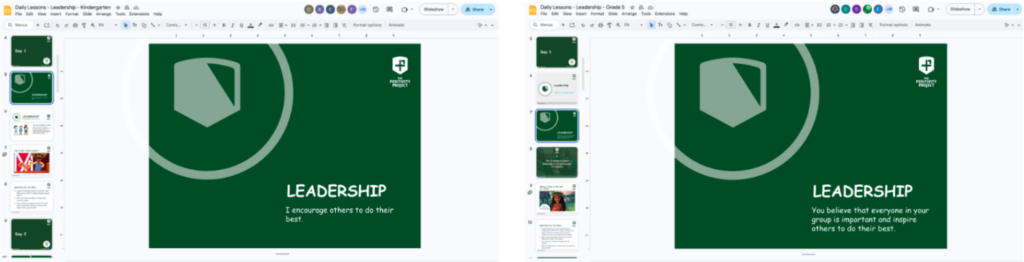
Photo showing side-by-side P2 lesson slides for kindergarten (left) and fifth-grade (right) on the same character strength and lesson day, illustrating how the curriculum maintains the consistent instructional architecture while scaffolding content and discussions to students’ developmental levels.
A kindergarten teacher and a fifth-grade teacher may be teaching the same character strength at the same time of year, but in ways that are developmentally appropriate for their students. This shared lesson architecture helps organically build a common language across the school community. Students begin hearing and using the same character vocabulary in the classroom, at recess, in the hallway, at lunch, and as they move from one grade level to the next.
Why this design works inside 15 minutes
Three principles make the architecture fit the time constraint:
One strength, multiple modalities. Across five days, students encounter leadership through a story, quote, video, activity, and journaling. Same concept, multiple cognitive doors. That’s the variation the learning science calls for — what Language and Consistency described as the combination of active learning, passive learning, and settling time that turns input into memory.
Off-the-shelf, not scripted. Teachers don’t have to plan. But they aren’t reading from a teleprompter either. The slides give them a clear path with room to bring their own voice. That’s what P2 means when it describes its resources as low floor, high ceiling — low effort to start, high room to grow.
Consistent structure across grades. As the Kindergarten-vs-5th comparison above shows, the same architecture runs the whole building. That consistency is what makes the language stick — and what makes the program teachable by every adult, not just specialists.
What the research says
The effectiveness of this design is supported not only by educational theory and best practices, but also by independent research.
Dr. Justin D. Garwood, Professor of Education at the University of Vermont, has conducted peer-reviewed research on P2 across elementary, middle, and high school settings. His findings include significant reductions in student behavior problems, stronger teacher-student relationships, and improved student sense of belonging. But for the purposes of this post, two findings matter most.
First, teachers implement P2 with 94% fidelity — nearly double the roughly 50% rate typically seen with social-emotional learning interventions. Fidelity is the technical term for the lesson actually getting taught the way it was designed. It’s the number that determines whether a curriculum lives or dies inside a building. Most programs fail this test quietly. P2 does not.
Second, Garwood’s research on educator experience finds that teachers don’t just implement P2 — they enjoy teaching it. One educator in his study described it this way: “I have never felt so good about a character education program in my teaching career. I can actually see this program working every day.”
What the research describes in statistics, teachers describe in their own words. Here’s Duane Engelman, a P2 teacher (and now a P2 principal), on the impact he observed in his classroom:
Duane Engelman, P2 teacher, on student engagement and the loop it creates for teachers.
That loop — kids respond, teachers see them respond, teachers reach for more — is what fidelity looks like from inside a classroom. The lesson continues because teachers see students engaged, making connections, and responding to the learning in meaningful ways. Over time, this creates a sense of ownership, where the work becomes embedded in classroom culture rather than viewed as another initiative to implement.
Why this design works across a year
Zoom out from one week. P2 covers a different character strength or Other People Mindset element every week — 24 strengths and the five OPM elements, each receiving this same intentional cycle of instruction, engagement, and reflection throughout the year. The calendar also includes six Spiral Review opportunities for teachers and students to revisit and reinforce previously taught strengths.
Multiply the architecture by 185+ lessons per grade level, and across every adult in the building speaking the same language, and something quiet happens. Students stop learning about character and start using its language to describe themselves and one another. The lesson becomes the language. The language becomes the identity.
That’s the bridge back to consistency. The cultural argument and the neuroscience both depend on the lesson actually getting taught — every day, by classroom teachers, without burning prep time the school doesn’t have. The three-phase architecture is what makes that math work. The research is what confirms it.
What we’re actually doing
When I talk with our curriculum developers, the framing they come back to is this:
We’re not just creating resources. We’re designing a learning experience.
That distinction matters. An activity fills time, but a learning experience builds understanding, gives students room to engage, and ends with reflection that helps the learning stick.
That’s what Understand, Engage, Reflect is. It’s not a slide template. It’s a developmental sequence, repeated 185+ times a year, that quietly turns a character strength into a way of seeing the world.
For students, the experience feels simple and familiar: a story, a discussion, an activity, and an opportunity to reflect. Beneath that structure, however, each lesson is intentionally designed to build understanding, strengthen relationships, and develop character over time. Across a school year — and across classrooms, grade levels, and staff members — this consistent developmental process helps transform character language into meaningful habits, behaviors, and beliefs that empower students to become their best selves.
That’s why the elementary school in North Carolina chose us after evaluating 16 options. Not because of marketing, but because when teachers taught the lessons, they saw students engaged in meaningful discussions, making personal connections, and applying the character strengths in authentic ways. That is also why, once teachers begin implementing P2, they continue using it year after year.
Curious what a P2 lesson looks like in your grade level? Start with our free lessons — no commitment, no signup required. Or request a quote to see what becoming a Partner School could look like for your building.