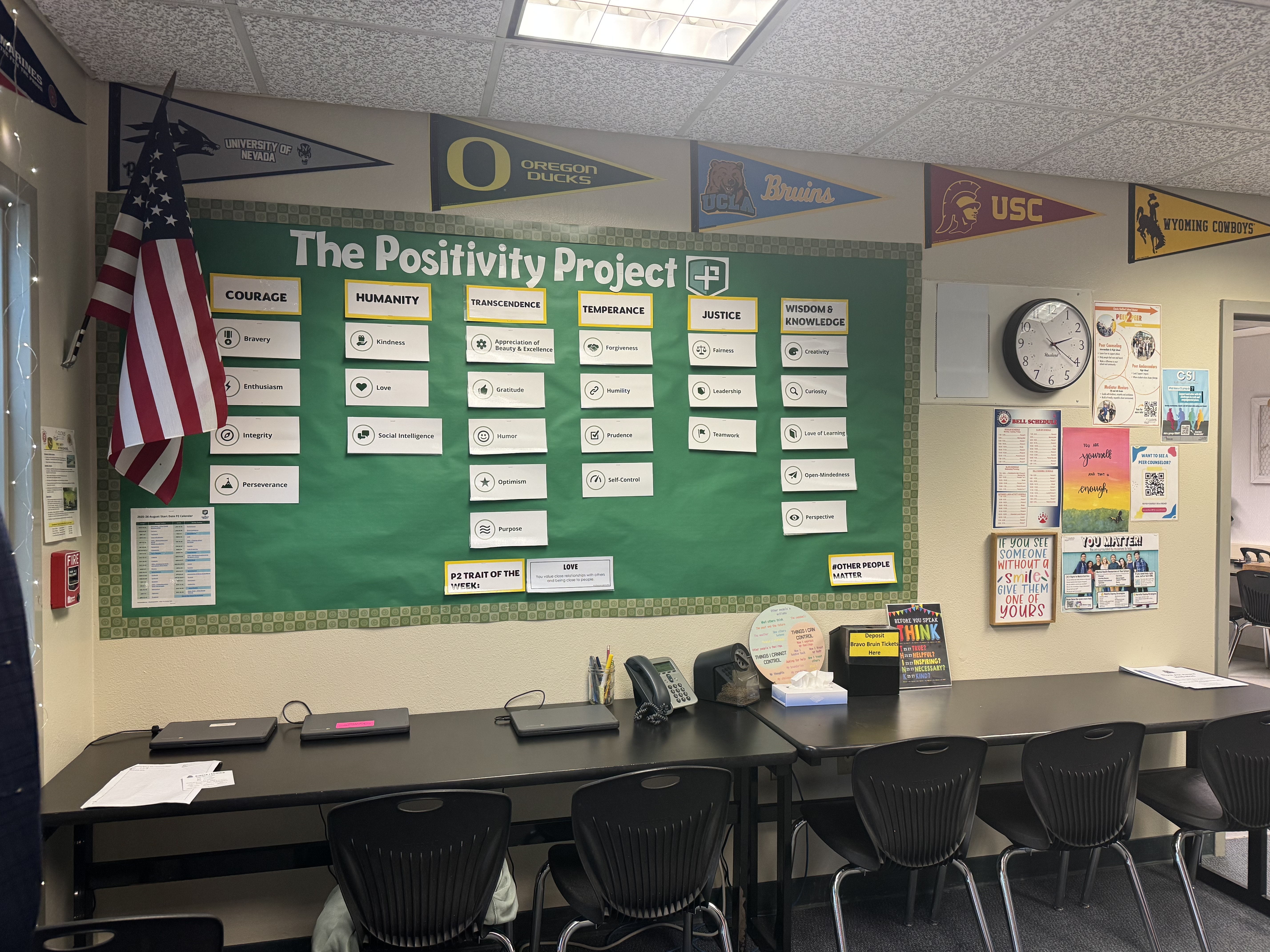
When teachers tell us what they love about P2, they almost never start with a specific lesson. They start with this: “It’s already built.”
That sentence carries more weight than it sounds like it does. A first-grade teacher walking into her classroom on a Tuesday morning in November has hundreds of decisions to make before the buses pull up. What P2 takes off her plate isn’t just “what should I teach for character today?” It’s the whole question. The week is Gratitude. The slide deck is loaded. The lesson is 15-minutes, with discussion questions and an activity already mapped out. She brings her voice and her students’ stories. We bring the path.
A teacher at one of our Partner Schools put it this way in a video we filmed last year: “From day one, new people, they could not make this easier on you. It is so beautifully done for you. It’s minimal work.”
That’s not an accident, and it’s not a small thing. It’s the entire reason P2 works.
Consistency Is the Mechanism
Our model is grounded in a piece of neuroscience that P2 CEO and Co-Founder, Jeff Bryan, has written about before: neurons that fire together, wire together. Eric Jensen lays it out plainly in Teaching with the Brain in Mind — synapses are not static. They adapt in response to activity. Repetition is what strengthens the connections in the brain, and spreading that repetition out over time is what turns short-term exposure into long-term memory.
Dr. Chris Peterson, one of the founders of positive psychology and the author of Character Strengths and Virtues, put it this way: “One-shot positive psychology interventions can probably jump-start the process, but only sustained practice will make changes permanent.”
That sentence is the whole argument for how character education has to be designed. If you teach a character strength once and move on, you’ve done a nice lesson. If you teach it, return to it, spiral back to it, and use the vocabulary every day for years, you’ve changed how a child sees themselves and the people around them.
The question is: how do you actually make that happen inside a real school, with real teachers, with real Tuesdays?
The Calendar Is the System
You build the year.
P2’s calendar is a Pre-K–12 pacing guide and a gateway to a full scope and sequence — architected for a school year that actually exists: a 40-week calendar covering the 24 character strengths and the five elements of the Other People Mindset, plus dedicated Intro and Outro OPM weeks, a Spirit Week, Spiral Review weeks at deliberate intervals, and end-of-year extension activities. Gratitude even gets two weeks, because the run-up to Thanksgiving is when it lands hardest.
When teachers open the calendar in August, they don’t see “here are some resources, good luck assembling them.” They see a year. Every week has a strength. Every strength has a slide deck. Every slide deck has five 15-minute lessons, with discussion questions, activities, and real-world scenarios. Every lesson is grade-differentiated, PreK-12. Off-the-shelf, but not a script. Some teachers read the slides as-is, and it works. Others bring their own stories and examples. Both are right. The slides aren’t a teleprompter you have to follow — they’re a clear path you can walk in your own voice.
A teacher from another Partner School told us why the calendar itself matters: “There’s always something more being put on our plate that has to be done, and where do we get the time in the day to fit it in. But it’s so easy to teach the traits — and the ready-made lessons that are updated.”
Because school years don’t all start in the same week, we publish two versions of the calendar — an August start and a September start. For schools on a year-round schedule, our team builds a custom calendar with them. And because every P2 resource is available to every Partner School all year long, schools that want to design their own pacing have everything they need to do that, too. The default is structure. The option is flexibility.
What that creates is a network of schools — most of them on one of the two main calendars — teaching the same character strength at roughly the same time. That shared rhythm is what powers the social media community: teachers find each other, share what worked, and see what other classrooms are doing in real time. It’s also what makes the strengths feel bigger than any one classroom.
This is the part of P2 that doesn’t show up in a sample lesson — pacing, curation, differentiation, spiral review, and flexibility. It’s what curriculum directors recognize immediately when they see it — the difference between a curriculum and a collection of lessons.
The Year Has a Rhythm
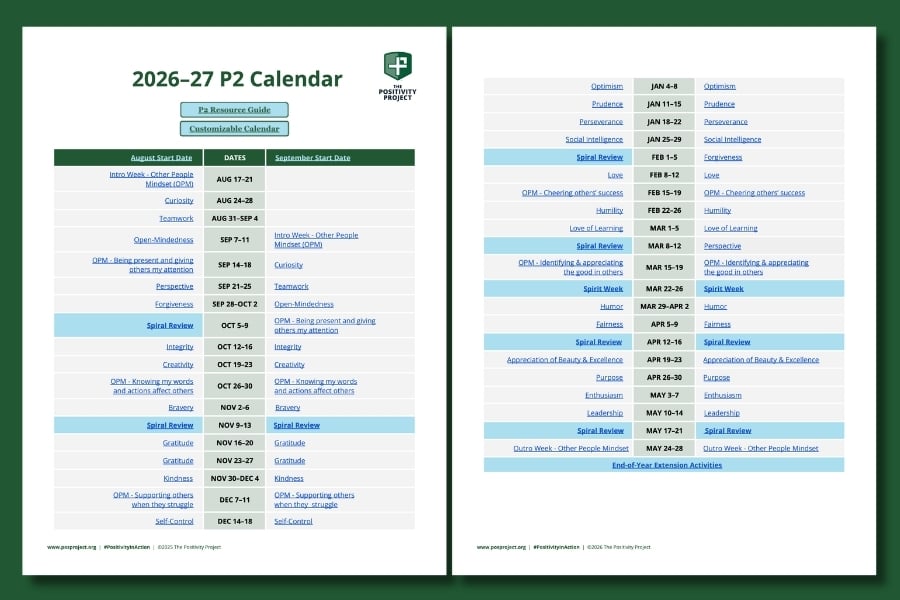
The calendar isn’t just built — it’s tuned to the year a student actually lives.
Gratitude lands in mid-November, the two weeks around Thanksgiving, when students are already thinking about what they’re grateful for. Kindness comes at the start of the holiday season, when the cultural emphasis on giving is everywhere a child looks. Self-Control lands the week before winter break, when classrooms need it most.
January opens with an arc that maps onto the psychology of New Year’s resolutions: Optimism the first week of the year (the hope that things can be different), Prudence the second week (making the plan), Perseverance the third week (sticking with the plan when it gets hard). It’s not a coincidence that those three sit next to each other on the calendar. It’s how resolutions actually work, or fail to.
Love is the week of Valentine’s Day. Humor lands near April Fools’. Appreciation of Beauty and Excellence falls around Earth Day. Spirit Week comes in March, when the long stretch between winter and spring break is at its hardest.
None of this is filler. The calendar puts each character strength in front of students at the moment of the year when they’re most primed to feel it, talk about it, and recognize it in their own lives. That’s a curriculum design choice we make deliberately, and we revisit it every year.
The Curation Nobody Sees
There’s something I want to name about how the calendar gets built, because I don’t think it’s obvious from the outside.
The internet has more high-quality educational content than at any point in history. There are extraordinary videos about kindness. There are documentaries on perseverance, articles on humility, picture books on bravery, and podcasts on every character strength grounded in Positive Psychology. The problem isn’t scarcity — it’s everything else.
A teacher who tries to assemble character education from open resources has to filter for age appropriateness, vet for safety, check length so it actually fits in a short enough time, and dodge the algorithmic drift that pulls every search a few clicks sideways from where it started. That’s an enormous amount of work, and most teachers don’t have the time. So the lesson either doesn’t happen or happens once and stops.
Our curriculum team does that work, year after year, for every grade level. We watch the videos. We read the books. We vet the clips. We write the discussion questions. We build the activities. We update what’s dated and replace what no longer lands. What ends up in a P2 slide deck is the small percentage of available content that’s safe, short enough to use, and actually connected to the character strength being taught that week.
That curation matters for a reason that goes beyond convenience.
"When a student sees a clear definition of a character strength, paired with a real example and a discussion they actually had in class, something happens — they start to see that strength in everyday life. They can name it. Without the definition and the examples, character is there, but it’s fuzzy. It’s in the background. The curriculum gives shape to the things kids see in the world."
The Spiral Review Story
For our first few years, the P2 calendar ran 31 weeks. That covered the 24 strengths and the five OPM elements, plus Intro and Outro weeks. It was clean and complete, and for the schools who used it, it worked.
But most schools run closer to a 40-week year, and our Partner Schools kept telling us the same thing: we love this, but what do we do with the rest?
Our first attempt was something we called Wild Card Weeks — open weeks at the end of the year for schools to make up snow days, vacation gaps, or strengths they’d missed. It was honest, but it wasn’t enough. Schools didn’t want a blank space on the calendar. They wanted something to teach.
So we went back to the research, and the answer was already there. Spiral review is a recognized instructional practice — teachers deliberately returning to previously taught content to lock it in. It’s how reading curricula work. It’s how math curricula work. And it maps directly onto the neuroscience we’d been writing about from the beginning: repetition strengthens recall, recall strengthens recall, and over time, the content moves from something a student learned once to something they actually know.
In 2023, we built the first round of spiral review decks by grade band. In 2024, we differentiated them by grade — every single grade level, Pre-K through 12, with its own set of lessons. Every spiral review week includes five character strengths to revisit, and each strength offers a teacher three options: an Understand lesson for students who still need foundational support, an Engage activity for students ready to practice, and Scenarios for students who can apply the strength in real-world situations.
That’s a built-in Tier 2 layer most character education programs don’t have. It’s also a lot of curriculum — five strengths times three lesson types times fourteen grade levels times six spiral review weeks across the year. We built it because schools asked for it, and because the research showed it was the right thing to do.
Why This Matters for Character
The reason P2 reaches 93-94% implementation fidelity in research studies isn’t because our lessons are uniquely brilliant. It’s because the calendar removes friction. A teacher who has to invent character education lessons every week will teach them inconsistently, no matter how committed they are. A teacher who opens a deck on Tuesday morning and teaches it will teach it every day. And every day is what changes a child.
What that looks like at the school level, over years, is the story Principal Eva Martinez tells about Discovery Elementary in California’s Fruitvale School District. Six years into P2 implementation, Discovery has seen chronic absenteeism drop from 17.7% to 5.5% — a 69% reduction over four consecutive years — and office discipline referrals fall 47%, from 777 to 408. As Eva describes it, P2 now extends across every layer of the school: “Our counselor, PE teacher, RBT, and school psychologist utilize P2 resources within Tier 2 and Tier 3 interventions.” The shared vocabulary isn’t living in the classroom alone. It’s the operating language of the building.
What that consistency adds up to inside a single classroom is something I couldn’t say better than Olivia Holmberg, a second-grade teacher at W.M. Irvin Elementary in North Carolina, did in a recent post:
“P2 gives us a shared language, a common goal, and a way to intentionally build a positive school community.”
She also describes what daily practice actually looks like in a classroom that’s been at this for four years: “We notice it in read-alouds, connect it to characters in stories, and reference it during writing, group work, and problem-solving activities.”
That’s what the architecture is for. The calendar, the curation, the spiral review — none of it exists to be admired. It exists so that a principal in California can run a school where kids show up and stay out of the office, and so that a second-grade teacher in North Carolina can spot a character strength in a read-aloud on a Tuesday in November and name it. Different buildings, different roles, the same architecture underneath. That’s what consistency looks like when it’s working.
Dr. Chris Peterson wrote that virtue is the product of habitual action. Aristotle said it twenty-three centuries earlier. What’s new isn’t the insight. What’s new is that we finally have the curriculum infrastructure to deliver on it inside a real school year.
That’s what the calendar is for. That’s what curation is for. That’s what Spiral Review is for. And that’s why, when teachers tell us “it’s already built,” they’re describing the most important thing about how P2 actually works.

Melissa Killingbeck
Melissa Killingbeck is the Curriculum Manager for The Positivity Project and ensures our resources are at their highest quality. Melissa earned her bachelor's degree and teaching certificate in elementary education and holds a Master's in Education with certification in K-12 administration. Before joining the P2 team, Melissa was a successful P2 Partner School principal in Flushing, Michigan, where she worked for 25 years as a teacher, instructional coach, and principal. After retiring from public education in 2019, Melissa relocated to northern Michigan with her husband Casey and their Silver Lab, Tank. When not knee-deep in P2 resources, Melissa can be found rockhounding along a lakeshore, enjoying a boat ride with Casey and Tank, or "downstate" visiting their two grown children.