

Character Meets Career: Introducing P2's New High School Resources
By Stephanie DiNola“We love P2, but our teachers don’t have time for another daily curriculum.”
This sentiment is not lost on me as a previous secondary teacher. The time we have with students is limited, and at times, sacred, to get through all the curriculum that is on our plates. To add in another “thing” is unheard of, let alone what that does to your pacing with other classes. A daily curriculum can work in an elementary school, even middle school, but high school is a horse of a different color. Curriculum aside, there are bell schedules, A/B day puzzles, block periods, and possibly advisory windows. To add “one more thing” carries a real cost—and pretending otherwise doesn’t help anyone.
Therefore, when our curriculum team set out to build P2’s new high school resources, we wanted them to fit into the school and schedule you already have. These resources are not another course, not another adoption to learn, not another program to pretend to use, but we all know we aren’t. These resources are here to enhance your teaching and help shape the future citizens that sit in your classroom daily, without putting any extra work on your plate as a teacher.
This post is your full look at what we built: the resources, how schools can use them, and most importantly, in my humble opinion, how a teacher can realistically interact with them on a weekly basis.
What we built
This new collection is intentionally called our High School Career Readiness resources. I use the word “intentionally” because many discussions were held among the broader P2 team about the moniker of these materials. We deeply want these resources to be an aid for schools to prepare their students for life—both during and after high school. Therefore, we need the name to align with what schools and districts are searching for.
As stated before, every high school is a beautiful, albeit sometimes messy, collection of ideals, schedules, cultures, and goals. The resources we have created are meant to be used by each high school differently—to fit into the quilt of your school’s week.
The collection has three parts:
Yet these are not three separate curriculums. These are three different pathways for high schools to take based on their building.
One set of resources, three ways in
One of the most important questions that our onboarding and implementation teams ask partner high schools is “What do you want to see in your students when they walk across the stage at graduation?”
There’s no denying that, as educators, we want students to understand the curriculum, to have a strong command of the content knowledge. However, what else are you hoping to see? As a district, are you focusing on character as a whole so that all schools are discussing the same strengths, creating a rhythm from building to building, student to student? Are you shaping your students through a Portrait of a Graduate construct? Are you hoping to sharpen students’ career skills for future employers through CTE or other business/career pathways? The good news is there is no right answer; hence why we have created three pathways. P2 can fit into your goals and your schedules.
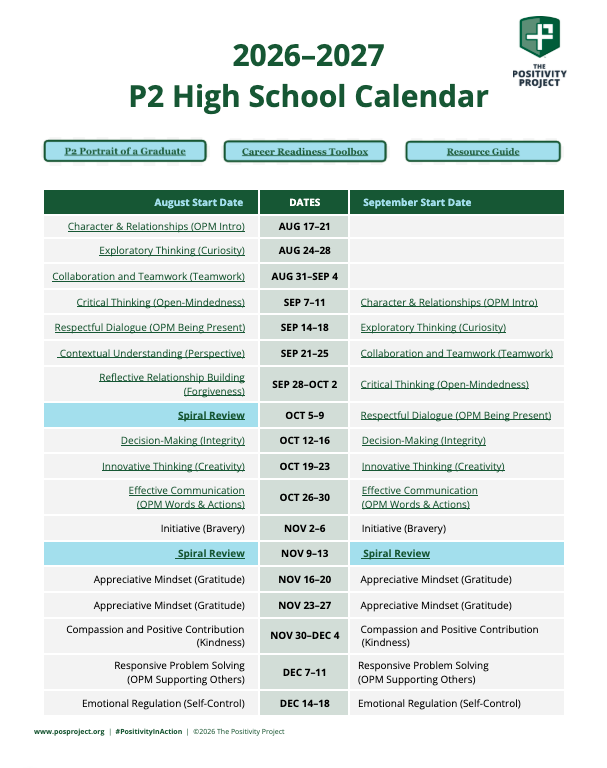
P2 High School Calendar follows the same week-by-week schedule as our nationwide August and September calendars. Therefore, students from PreK–12 will all be discussing the same strengths, the same week. Families will be hearing about perseverance from their elementary student alongside their high school senior. What’s new about this high school calendar is how we have framed these tried and true character strengths: each week is anchored by a Portrait of a Graduate attribute alongside the character strength or Other People Mindset element. For example, Curiosity on the nationwide calendar is Exploratory Thinking (Curiosity) on the high school calendar. If your district runs P2, you’re not starting over — you’re adding a high-school-ready layer on top of a foundation your students already have. If your goal is a shared, district-wide sequence, start here.
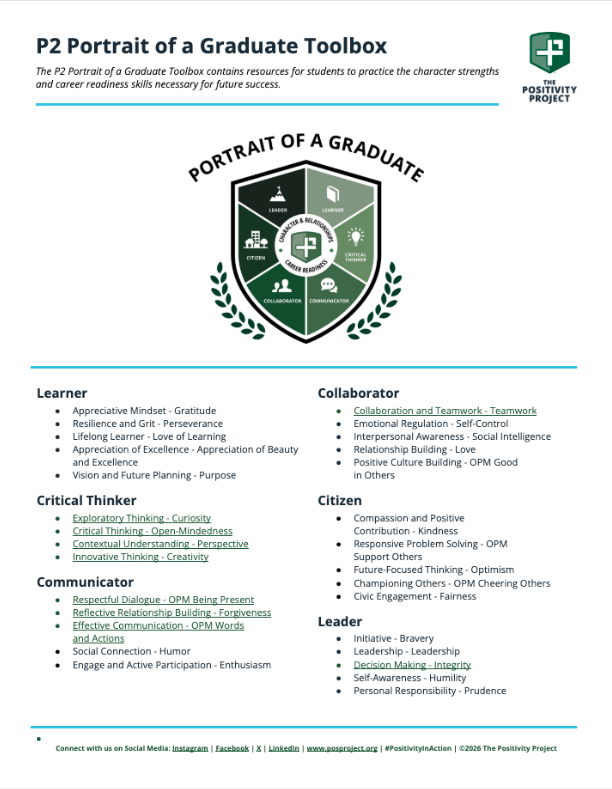
The P2 Portrait of a Graduate organizes the same lessons found on the calendar by the six Portrait of a Graduate attributes—Learner, Critical Thinker, Communicator, Collaborator, Citizen, and Leader—each mapped to its underlying character strengths and OPM elements. If your school leads with its Portrait of a Graduate and wants the freedom to choose which attributes to focus on, and in what order, this is your path.
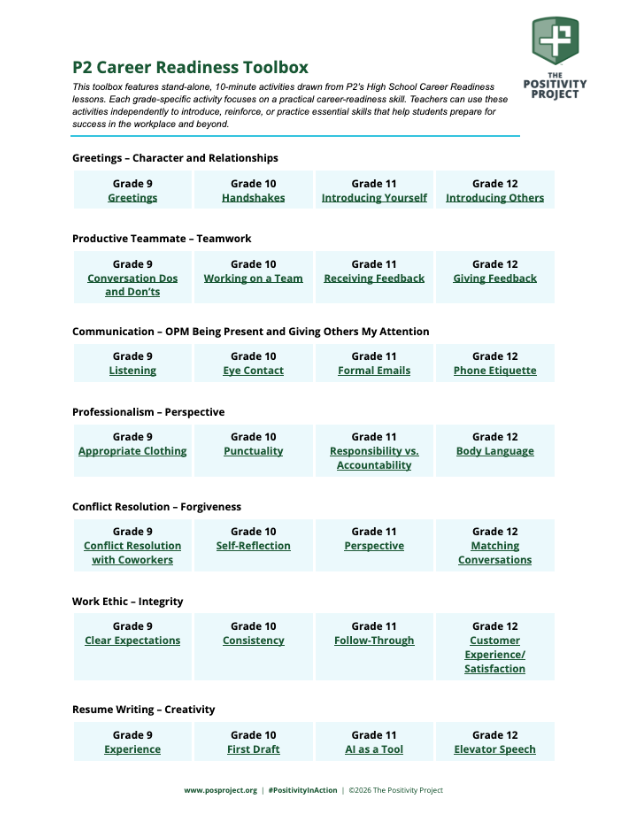
The P2 Career Readiness Toolbox organizes the career-readiness side of the same resources by practical, workplace-ready themes that build across grades 9–12, with skills such as communication, professionalism, conflict resolution, work ethic, resume writing, interview prep, and more. A ninth-grader works on first impressions the moment they walk into an interview; by twelfth grade, they’re discussing the importance of follow-up thank-you emails to interviewers and what should be included. If you’re teaching a CTE pathway, a business class, or any program focused squarely on career skills, this is the most direct way in.
A school never has to choose between character and career, or between structure and flexibility — it picks the trail that matches how it already works and its ideal destination.
Inside a weekly lesson
Our curriculum development team is composed of teachers. We know the demands. We understand the stress. We feel the annoyance of an adoption of yet another program with its philosophies and promises. Yet at the end of the day, teachers want to know the what.
What am I going to teach?
Our simple answer is an off-the-shelf slide deck mapped out to give teachers a single touchpoint each week. No extra work required.
Let’s walk inside a deck: Grade 9 – Exploratory Thinking (Curiosity).
Each weekly lesson opens the same way — by explaining the Portrait of a Graduate attribute and how it connects to a character strength or OPM. Here, students learn how curiosity inspires them to ask questions, explore new ideas, and seek information beyond what they already know. This exploratory thinking helps students consider possibilities, deepen their understanding, and discover new ways of viewing the world. That shared definition gives the whole class the same starting language.
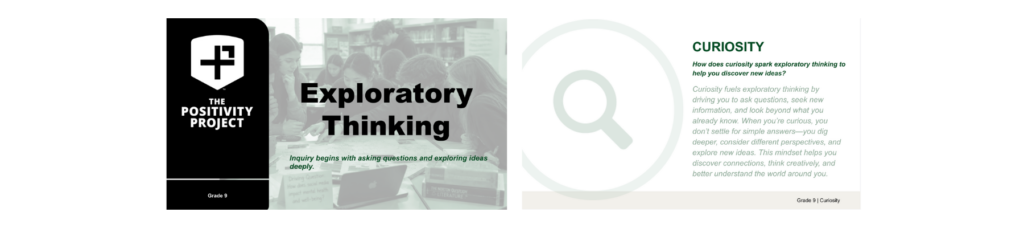
Once students are grounded in this understanding, the deck opens up to three ready-to-teach components, each designed to run in about 10 minutes.
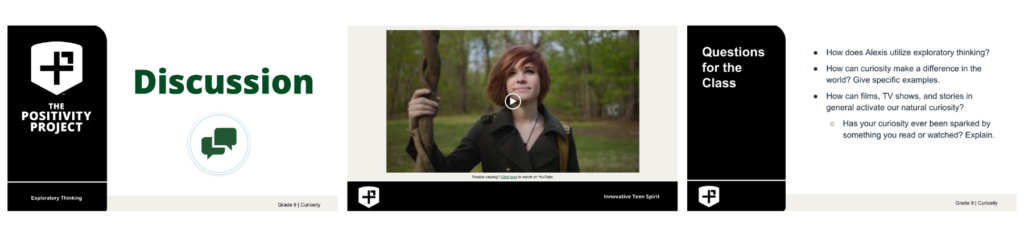
Discussion. Students watch a short video, then work through questions as a class. In a few minutes, an abstract word becomes something students can see and name.
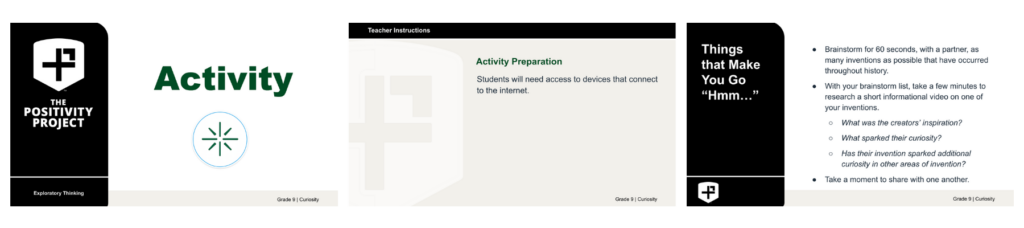
Activity. This is where character strengths become something students do. This moves beyond understanding to a place of application.
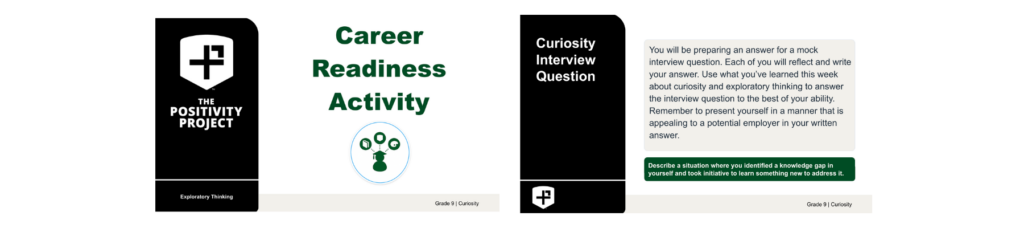
Career Readiness Activity. Here’s the bridge to the working world. Suddenly, “curiosity” isn’t just a vocabulary word — it’s a career-ready strength that encourages students to ask thoughtful questions, explore new ideas, and seek out possibilities. Students discover how exploratory thinking can help them solve problems, adapt to change, and identify future career paths.
Here’s what makes that structure work for real schedules: the three components are built to stand alone or fit together. A school with a dedicated weekly block — an advisory or homeroom period — can teach all three back-to-back as a single 30-minute weekly lesson. A school with only 10 minutes a week can have each teacher choose the one component that best fits their students that week — the discussion, the activity, or the career-readiness lesson — and vary it from week to week. Either way, one thing stays constant: no matter which components a school uses, every class is still focused on the same Portrait of a Graduate attribute and character strength that week. That’s the balance we were after — flexibility for the teacher, alignment for the whole building.
That structure holds across every strength and every grade. Swap Curiosity for Perseverance or Social Intelligence, or a Grade 9 lesson for a Grade 12 one, and the shape stays the same: understand the attribute, engage with it, apply it to the real world.
Why this works in a real high school schedule
A few deliberate choices make these resources fit the constraints high schools actually live with:
They fit the time you already have. These lessons are built for the advisory or homeroom window most schools already hold — not a new period, and not a course competing with academics. Take them à la carte.
We curated, so teachers don’t have to. The fastest way to stall character work in a high school is to hand a busy teacher a library of two hundred resources and a free afternoon. Too many good options is its own kind of paralysis. So we chose and sequenced the strongest lessons for each week. When a teacher opens the calendar, the answer to “What do I teach?” is already there. They can still go their own way — the difference is that the default is a strong one, not a blank page.
No specialized training is required. Because the structure is consistent and the prep is minimal, these lessons are designed to be taught confidently by the educators who already know their students best.
And because the resources work whether a school uses dedicated instructional minutes or weaves character language into school-wide culture, they flex to fit how each building brings P2 to life.
Character and career are the same student
It’s tempting to treat character education and career readiness as two different projects. They’re not. They’re two views of the same young person.
The Portrait of a Graduate side shapes the human — curious, resilient, self-aware, a good teammate. The career-readiness side shapes the professional — someone who can give and receive feedback, resolve conflicts, follow through, and tell their story in an interview. Technical skill is what gets a young person the job. These human skills are what keep them in it. We’ve all met the technician who can fix anything but can’t talk to the customer — that’s exactly the gap these resources are built to close.
That’s why every weekly lesson deliberately connects a character strength to its real workplace use. The curiosity a student explores on Wednesday is the same curiosity they’ll describe to an employer on Friday.
What’s ready, and how to get started
The High School Career Readiness resources are rolling out for the coming school year. The first quarter of the calendar is now ready, with each subsequent quarter landing ahead of its marking period. You can find all three paths — the Calendar, the Portrait of a Graduate, and the Career Readiness Toolbox — through your P2 Resource Menu and Resource Guide.
If you’d like to see how it all fits together, current partners: watch for our August webinar, where our team will walk through the resources and show you exactly how to fold them into the year ahead.
And if you’re new to P2, this is a great place to start:
Explore our free lessons with no signup required, take a closer look at P2 for high schools, or request a quote to see what these resources could look like for your students.
Character shapes the human. Career readiness shapes the professional. High school is where those two finally meet, and our team is proud of what we’ve built to help them meet well.