

The Positivity Project and Blue Star Families Bring Free Blue Star Welcome Week Resources to Schools
By Melissa KillingbeckMelissa Killingbeck is a former elementary teacher and principal who has welcomed hundreds of new students through her school doors. Here she shares how The Positivity Project’s partnership with Blue Star Families gives educators free, ready-to-use lessons that help students turn a greeting into genuine belonging.
A Welcome Is More Than a Greeting
A welcoming school is one where every child feels included, supported, and connected—and students play an important role in making that happen.
As an elementary teacher and later a principal, I saw this scene play out many times. A new student would walk through our doors, surrounded by classmates who already knew the routines, the hallways, the lunchroom, and the unspoken rules of the school. They knew where to put their backpack, which hallway led to the gym, and who they could sit with at lunch. The new student was starting from scratch.
A caring teacher would smile. Classmates might say hello. But the moments that mattered often came later: Who invited that student into a game at recess? Who noticed the student sitting alone at lunch? Who explained the routine without making the student feel embarrassed for not knowing it?
Those small moments are where belonging begins. And they are exactly why The Positivity Project (P2) is proud to partner with Blue Star Families for Blue Star Welcome Week 2026.
Why Blue Star Welcome Week matters
Each year, more than 600,000 military families move to new communities — new mission, new boots on the ground. For children, a move can mean leaving friends, teachers, teams, familiar routines, and places that felt like home — only to enter a new school where relationships have already formed.
Blue Star Families, a national nonprofit that supports military and veteran families, created Blue Star Welcome Week to help military families feel a sense of belonging, connection, and support wherever they go. This year’s Welcome Week takes place September 26–October 4, 2026.
For a child who is new, school is often the first place where an unfamiliar community starts to feel like home. It’s also where they begin to figure out, sometimes without even realizing it, whether they feel like they belong.
Why this partnership makes sense
At P2, our mission is to empower America’s youth to build positive relationships and become their best selves. Through the 24 character strengths and the Other People Mindset, students learn to recognize the good in themselves and others and put relationships first by being present, using kind words and actions, supporting others when they struggle, celebrating their successes, and identifying and appreciating the good in others.
Blue Star Families brings a deep understanding of what military families experience when they move and start over. P2 brings simple, everyday tools that help students know what to do with that understanding –– how to notice when someone is new, include them, support them, and help them feel like they belong. Together, they make welcoming others something students can practice, not just something we ask them to do.
That matters for military-connected students, and it matters for every student who has ever entered a new classroom, joined a new team, moved to a new community, or wondered where they fit.
What schools will receive — for free
P2 and Blue Star Families have created free, ready-to-use classroom resources especially for Blue Star Welcome Week for five grade bands: Pre-K–K, grades 1–2, grades 3–5, grades 6–8, and grades 9–12.
Each grade-band slide deck follows P2’s familiar five-day lesson format, with daily 10- to 15-minute lessons featuring age-appropriate language, videos, discussion questions, activities, scenarios, and opportunities for students to reflect and take action. The week is organized around five intentionally selected character strengths that help students turn welcome into action:
Perspective: Trying to understand what it may feel like to enter a new school or community.
Bravery: Recognizing the courage it takes to start over — and the courage it takes to reach out first.
Social Intelligence: Noticing another person’s thoughts and feelings, especially when they may not say them aloud.
Kindness: Using small, intentional actions to help someone feel included.
Gratitude: Appreciating the people, places, experiences, and memories that help us grow through change.
What the five days look like in a classroom
In the grades 3–5 lessons, Day 1 begins by introducing perspective and exploring how it can help students understand what being new may feel like. Students learn that moving can bring excitement along with feelings of uncertainty, fear, or loneliness. They then watch a video and discuss what a new classmate might experience, including worries that others may not recognize.

Lesson structure example: Grades 3–5, Day 1: Perspective
On Day 2, students explore bravery — not as the absence of fear, but as moving forward even when something feels uncertain. Day 3 focuses on social intelligence as students work through realistic school scenarios: a student sitting alone at lunch, arriving late because they could not find the classroom, or frequently talking about an old school because it is still the place they know best.
Through the lens of kindness on Day 4, students plant “seeds of kindness” by making intentional choices such as sitting with someone who is alone, offering help, giving a genuine compliment, or inviting someone to join. On the final day, they reflect on gratitude and how the people, places, and memories we carry with us can help us grow through change.
The examples and depth of reflection vary across grade bands, but the goal remains the same: to help students understand another person’s experience and give them meaningful ways to act on that understanding.
Belonging is built in ordinary moments
Belonging is often built in the little moments that might seem ordinary to us but can mean everything to a child who is new. It’s the classmate who saves a seat at lunch, shows them where to go, remembers their name, or asks what their old school was like. It’s the student who recognizes that a new classmate may look happy and confident on the outside while feeling nervous and unsure on the inside.
These gestures don’t require anything big or complicated. They simply require children to notice the people around them and recognize that a small act of kindness can make a big difference. For a child who is trying to find their place, something as simple as “Come sit with us” can turn an overwhelming day into one in which they begin to feel they belong.
That is the purpose behind Blue Star Welcome Week. We can certainly help students learn about the experiences of military-connected families. More importantly, we can help them practice becoming the kind of classmates and community members who make a new place feel like home — for everyone.
Bring Blue Star Welcome Week to your school
The complete Blue Star Welcome Week Toolbox is free and available to all schools — whether or not they currently partner with The Positivity Project. Access the Pre-K–12 resource toolbox, choose your grade band, and use the lessons during Blue Star Welcome Week, September 26–October 4, 2026.
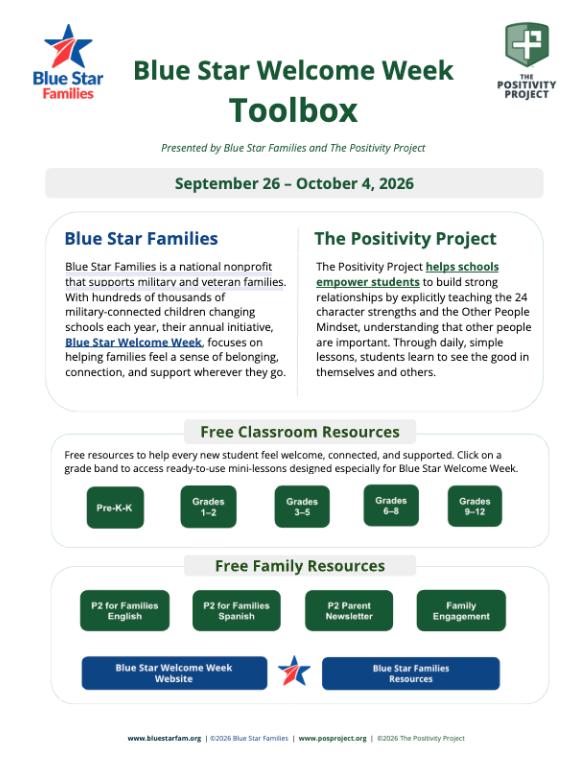
You can also learn more about The Positivity Project, Blue Star Welcome Week and the year-round work of Blue Star Families.
A welcome opens the door. Belonging is built in all the little moments that come after.