


The Power of Positivity: Building a Positive School Culture at Palms Elementary
By Mike DomagalskiThis partner school story was written by Mike Domagalski, Principal of Palms Elementary School in Fair Haven, Michigan. A veteran principal in the East China School District, Mike draws on years of experience leading multiple school-wide implementations of The Positivity Project to share how a deliberate focus on relationships and character strengths is helping build a positive, connected school culture.
Building Character, Building Community
At Palms Elementary School, we’ve always believed that academic success and character development go hand-in-hand. In January of 2025, our staff embarked on a journey to strengthen that connection by implementing The Positivity Project (P2). Since then, we’ve seen a powerful shift in how our students and staff think, speak, and act—not just inside the classroom, but throughout the entire school community.
When we adopted P2, our goal was simple: build a positive school culture that values relationships and character as much as academics. We wanted to help students understand what it truly means to “think of others” and recognize the character strengths within themselves and those around them.
Daily Implementation: Intentional and Consistent
After a light implementation at the end of the 2024/25 school year, we were seeing the benefits and the intentionality of why having the conversation around the character strengths were important. Our staff saw it, our students saw it, our behaviors started to improve and our academic scores took a leap.
For the 2025/26 school year, every classroom at Palms Elementary now integrates P2 into the daily routine. Teachers implement grade-level P2 slides at least three to five times per week, weaving the lessons into morning meetings, transitions, and classroom discussions. It’s not a “once-in-a-while” activity—it’s a deliberate part of our school day.
To ensure consistency, teachers include dedicated P2 or Character Time within their daily schedules, which are submitted to me as the building principal. This structure ensures that every student, regardless of grade level, receives intentional time to learn and reflect on positive character traits.
The beauty of P2 lies in its simplicity. It doesn’t require hours of preparation or specialized training. Instead, it provides teachers with quick, meaningful lessons and activities that naturally fit within the flow of a school day.
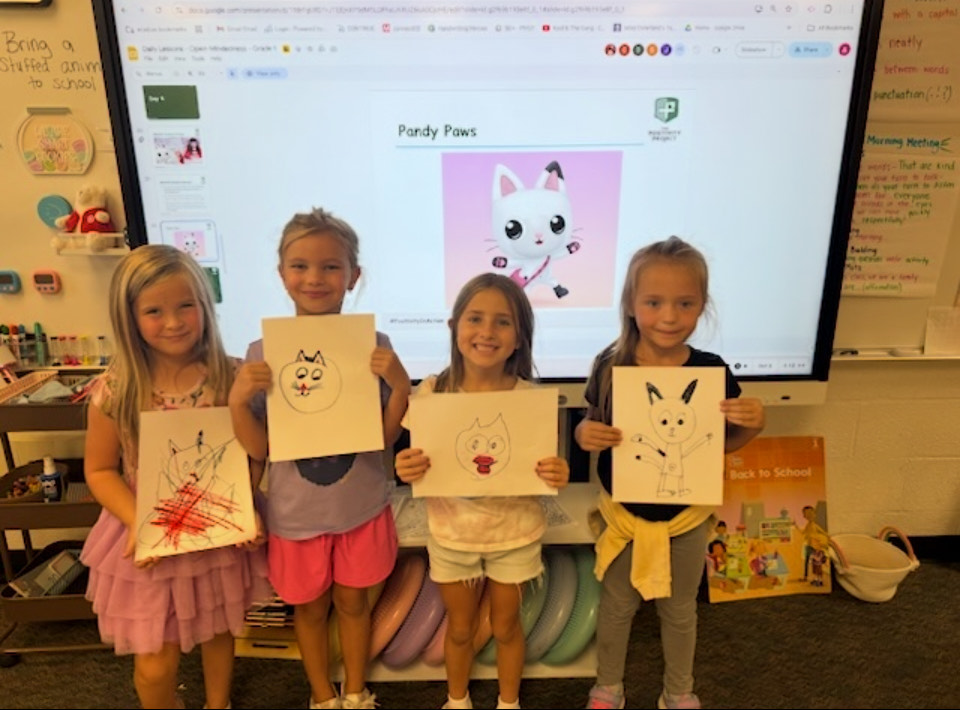
1st graders at Palms Elementary School took part in an Open-mindedness activity. They closed their eyes and tried drawing Pandy Paws from Gabby’s Dollhouse. They loved the project and showing off their artistic skills with each other!
Shifting School Culture Through Common Language
One of the most visible changes we’ve noticed is the language our students and staff are using. P2 has given us a shared vocabulary—words like perseverance, kindness, open-mindedness, and teamwork are now part of the conversation and thought processes.
During our monthly ‘Student of the Month’ celebrations, we now highlight students who embody the character strengths that were part of the month’s conversations and activities. Our assemblies now focus as much on who students are as on what they’ve achieved. The shift has been positively noticeable.
Even in the hallways, playground and cafeteria we can hear students using P2 language with one another. They’re more aware of how their words and actions affect others. They’re quicker to recognize strengths in their peers and more open to self-reflection.
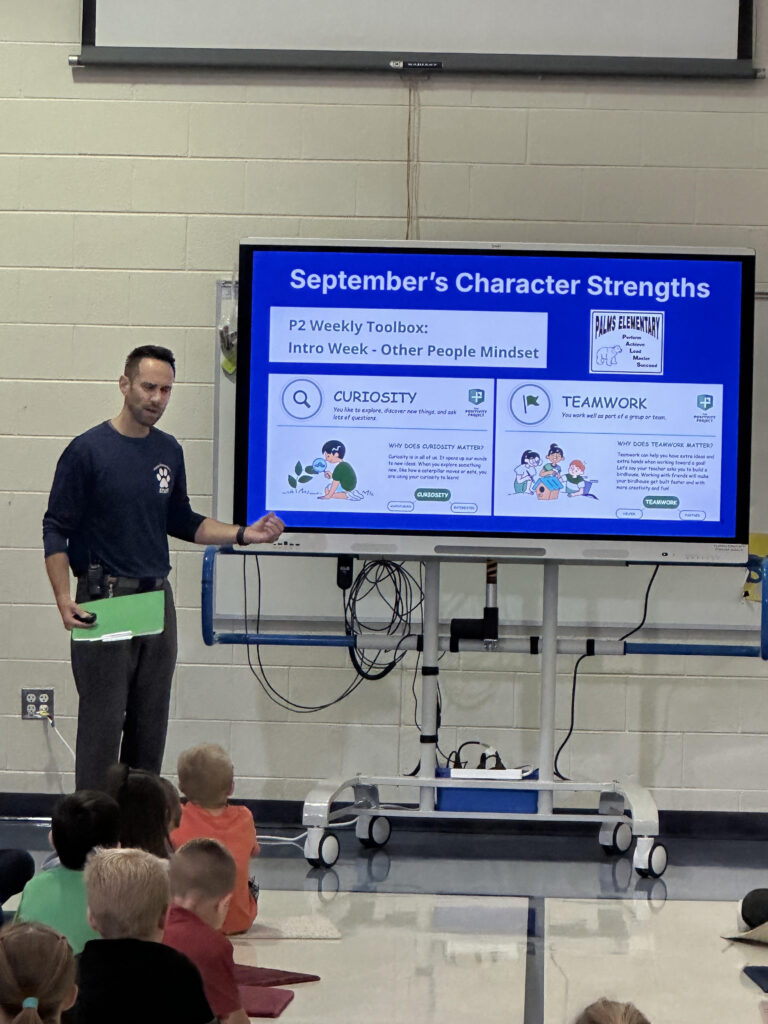
Principal Mike Domagalski reviews the Character Strengths of the month with the school, then presents the correlating Student of the Month awards.
A Story of Empathy and Teamwork
A few weeks ago, I had a conversation with a student—let’s call him Ryan. He came up to me after lunch to share that another student, Marcus, was struggling with his emotions in class. Instead of ignoring the situation or walking away, Ryan told me he remembered what we had been learning in P2 about being open-minded and teamwork. He said:
I just tried to think about what he was going through and how I could help. I did my best to include him as part of our team, even though I knew it was going to be hard.
That single moment captured the very essence of P2. Ryan didn’t act because an adult told him to. He acted because he understood empathy and connection. P2 gave him the language and the confidence to put those ideas into action.
This kind of behavior isn’t an exception anymore—it’s becoming the norm at Palms Elementary.
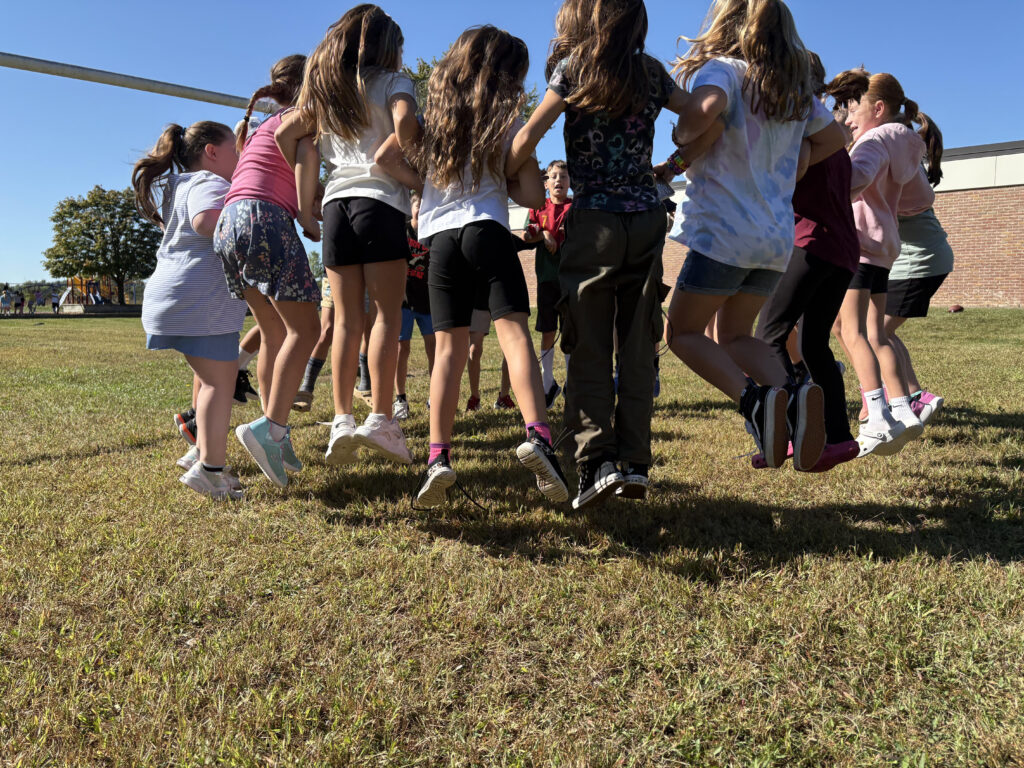
4th grade students try, and master, a “Group Jump” using silent teamwork. The students loved this and learned they need to work together in order to have success. This was done during Teamwork week, and our teachers are always coming up with fun ways to integrate the P2 Character Strengths into their daily schedule.
Observable Impacts: From Classrooms to the Cafeteria
Since implementing P2, we’ve seen a noticeable improvement in the overall tone of our school. Classrooms are working together around a common vocabulary, relationships are stronger, and the level of respect between students and staff has grown.
Students are using their character strengths to navigate challenges, resolve conflicts, and build friendships. Some teachers have reported that students often seem more reflective about their behavior and are more likely to hold themselves accountable.
Even in less structured settings—like lunch or recess—the impact is clear. Students use the P2 vocabulary to describe what’s happening: “I showed perseverance in the game today,” or “We used teamwork to clean up our table.” That kind of self-awareness is exactly what we hoped for when we started this journey.
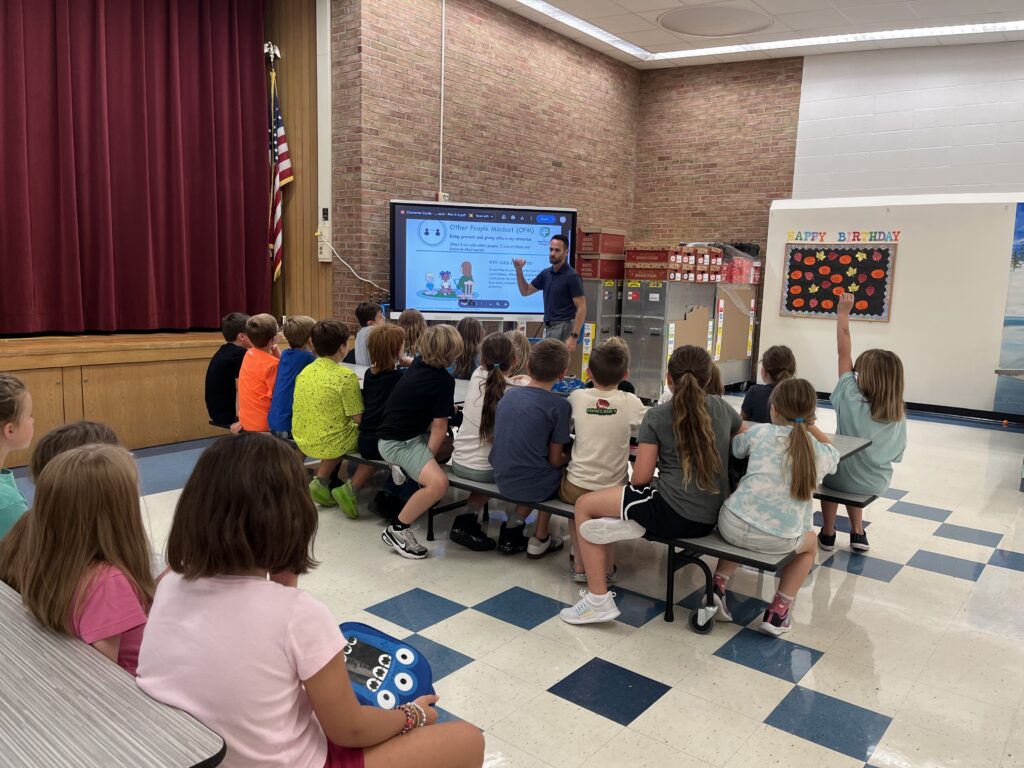
Principal Mike Domagalski often speaks to his students at lunchtime about the Character Strength for the week. This emphasizes and reinforces what the teachers are doing in their classrooms. Good conversation can happen around these strengths at any part of the day.
Strengthening the Home-School Connection
Another major success of P2 has been how it connects school and home. Each Friday, families receive a school newsletter that includes the information to the Parent Portal for family discussion questions. Several parents have told us how much they appreciate these resources—and how their children are leading conversations at the dinner table about what they’re learning at school.
At Parent-Teacher Conferences, one parent recently shared:
My daughter explained what having integrity means and how she used it to stand up to what was right and tell the truth because she wanted to be known as someone who can be trustworthy to her family and friends. Now our whole family talks about the character strength of the week on a week-to-week basis.
That’s the kind of partnership we love to see—students taking the lead in positive conversations that extend beyond the classroom.
Why We Chose P2
When we were searching for a program, we wanted something that addressed the whole child. Academics matter deeply, but without strong character, kindness, and a sense of belonging, learning doesn’t flourish.
We chose P2 because it gives students tangible ways to understand abstract ideas. It ties character strengths to real-life experiences—like teamwork at recess, honesty in group projects, or gratitude during lunch duty. It’s also easily adaptable, allowing us to embed it in our morning announcements, classroom lessons, signage around the school, and monthly celebrations.
P2 isn’t an “add-on” program—it’s become a part of who we are as a school.
Making It Our Own
While we stay true to the P2 framework, we’ve made it uniquely ours. Morning announcements now include examples of the character strength for the week. The announcement examples within the program give us a template to go off of when starting our day, oftentimes connecting the templated announcement to something happening in our school. Teachers incorporate P2 discussions into their classroom meetings, and our cafeteria staff even participate by promoting teamwork and respect during lunchtime.
We’ve adapted the P2 calendar to reflect our Student of the Month celebrations, which has worked wonderfully. In addition, classrooms will visit other classrooms, we call this “class partnerships,” and perform some kind of a P2 activity or a teamwork activity of this kind of nature. The older students will teach, or work with, younger students. These classroom partnerships have really strengthened our school’s culture and make P2 feel authentic and relatable.
Why P2 Matters to Us
At its core, P2 helps us answer the question “Why do we do what we do?” By focusing on relationships, empathy, and self-awareness, we’re building the foundation for all other learning.
In a world that can often feel fast-paced, disconnected or divided, P2 gives our students—and our staff—a reminder to slow down, reflect, and care for one another. It supports our mission of helping students grow not just as learners, but as people.
Without a program like P2, we’d be missing a vital piece of the puzzle. We wouldn’t have the common vocabulary or shared focus that now drives our school culture. P2 gives us direction and unity.
Meeting Students’ Needs, One Strength at a Time
Perhaps the greatest success of all is how easily P2 fits into our daily rhythm. Our staff doesn’t focus on the character strengths within P2 on being “one more thing” — it’s something meaningful and manageable. It’s quick to implement, yet its impact is lasting.
Students engage with it because it’s relatable. It helps them understand themselves and others. And it’s fun.
Through P2, we’re teaching essential life skills, what some may call “soft skills;” however, we view them as “essential skills.” It’s easy to defend why these aspects in teaching and learning are crucial in school, in future careers, and in life.
Looking Ahead
As we move forward, we’ll continue to build on the foundation that P2 has given us. The program is transforming our school culture, strengthening our relationships, and helping us see each other through a more compassionate lens.
At Palms Elementary, the implementation of the Character Strengths within The Positivity Project is more of a mindset shift as opposed to a program. It’s the way we teach, learn, and live together. Ultimately, as our students continue to grow in character and confidence, we know the impact of P2 will last long beyond the classroom walls. That is the meaning and effect of true Whole Child Development!