

How One Middle School Increased Student Safety and Belonging in One Quarter
By Steve KiblerIn just one quarter of school-wide implementation, West Lake Middle School saw meaningful gains in student well-being and school culture, with student reports of feeling safe at school increasing from 66% to 75% and the percentage of students who felt their teachers cared about them as individuals rising from 54% to 87%—a 33% increase.
This reflection was written by Steve Kibler, Alternative Learning Center/In-School Suspension Teacher in the Wake County Public School System, and shares the school’s journey toward building a shared language of character, belonging, and connection through The Positivity Project.
West Lake Middle School in Apex, North Carolina, welcomes students from 33 different feeder schools, creating a uniquely diverse community. While our area has high median income and home values, 39.5% of students qualify for Free and Reduced Lunch, reflecting a broad range of life experiences. As our principal notes, “Our school represents America,” mirroring national demographics. This diversity is a strength, but it brings challenges in building a shared sense of belonging and understanding that are central to our school’s mission.
When Academic Success Isn’t Enough
Although we continue to make steady academic gains despite these challenges, we recognize that academic achievement alone is not enough. To truly support our students, we must strengthen their social-emotional well-being and help them grow into compassionate, responsible citizens prepared to thrive in a complex and changing world. While we had access to Social Emotional Learning (SEL) resources and implemented them with fidelity, we found that the lessons lacked engagement for both students and staff. Classroom discussions were limited, and the terminology—although defined—was often unclear, leading to broad or inconsistent interpretations. Even simple expectations such as “Be Kind” or “Use Kind Words” were understood differently based on students’ cultural backgrounds and prior experiences.
Without a shared language, these expectations lacked consistency and meaning. We needed a systematic, evidence-based approach that would unite the entire school community, regardless of role.
During this same time, we reviewed data from our Family School Relationship Survey, which revealed concerning trends. Our Spring 2025 school climate approval score was 45%, significantly lower than that of surrounding schools and the district average. Additionally, only 66% of students reported feeling safe at school, and just 54% felt that their teachers cared about them as individuals, not just as students.
These results prompted honest reflection. While resources were in place, they often functioned in isolation and reached only a small group of students. These results showed us that isolated resources were not enough—we needed a consistent, school-wide method to support every student daily.
That search led us to The Positivity Project.
Improving Student Sense of Safety and Belonging
After learning that several nearby schools had successfully implemented P2, we arranged a visit in mid-June 2025 to observe the program in action. Our administrators, counselors, social worker, and Alternative Learning Center teacher immediately recognized its potential. Despite having already finalized our master schedule for the school year—which began July 28, 2025—we made the bold decision to restructure the day to include dedicated daily time for Positivity Project instruction across all grade levels. This decision sent a clear message: social-emotional learning is not an add-on, but a priority.
The impact was almost immediate. Classrooms became spaces for open, respectful dialogue where students felt safe sharing their perspectives. P2 provided a common language of character strengths, helping both students and staff develop a shared understanding of strengths such as kindness, gratitude, perseverance, and empathy—and what they look like in action within our school community.
This shift extended well beyond classroom discussions. Throughout the building, high-traffic areas feature displays of the current week’s character trait—32 in total—created and maintained by our National Junior Honor Society students. Each morning begins with our principal, Mr. Shipp, reading The Positivity Project–provided scripts tied to the weekly character strength during announcements. Classrooms highlight the strength in visible and meaningful ways, and many teachers have extended the daily lessons through creative adaptations, such as reflective worksheets, varied discussion formats, or gratitude sticky-note displays that spread positivity throughout the school.
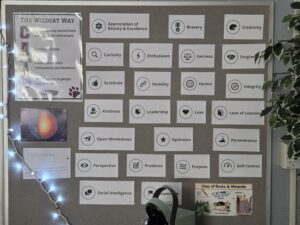
As teachers observed one another’s adaptations, collaboration naturally followed. Teachers began sharing ideas and working together to increase student engagement, leading to broader ownership and innovation across grade levels. In our Alternative Learning Center and In-School Suspension classroom, reflection sheets now prompt students to identify which character strength was impacted by their choices, fostering accountability and growth rather than punishment alone.
Our counselors also use The Positivity Project to support students through Tier 2 and Tier 3 small-group interventions. Additionally, leadership activities aligned with P2 are embedded into monthly Student Ambassador meetings, further strengthening student leadership, collaboration, and positive school culture.
The Immediate Impact of The Positivity Project on Our School Culture
After just one quarter of implementation, our data tells a powerful story. Following the first quarter, students completed a school-based survey that included the same questions that raised concern during the 2024–2025 school year. The results showed significant improvement:
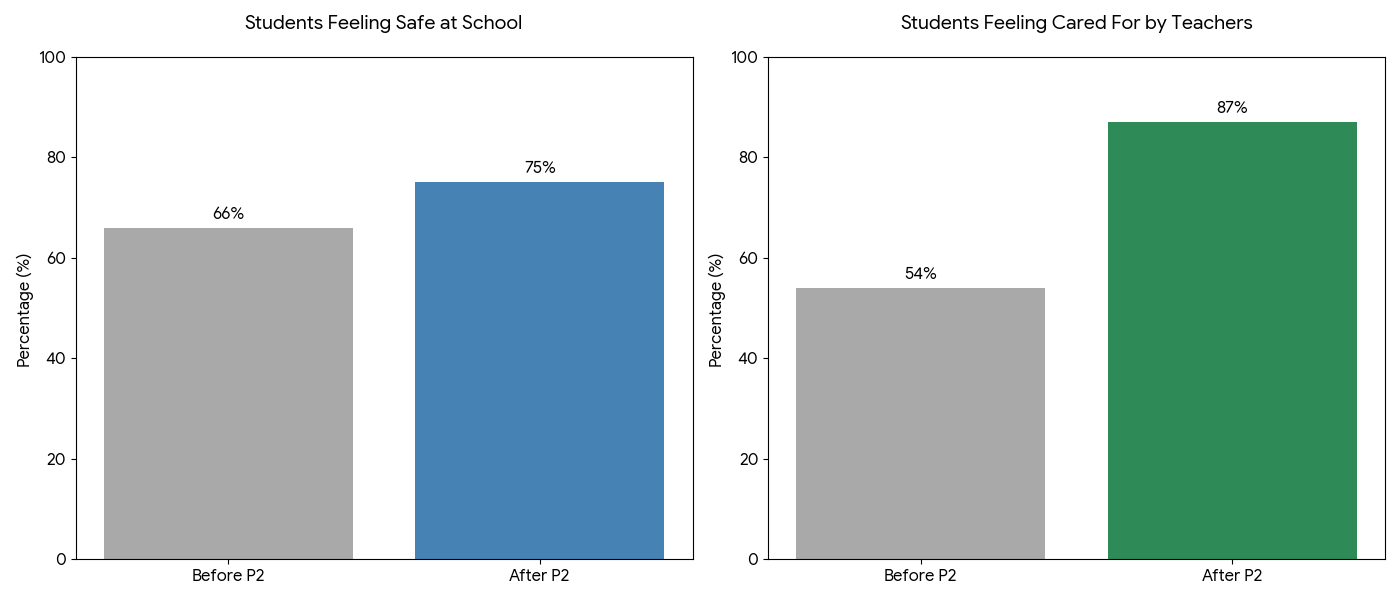
- 75% of students reported feeling safe at school—physically, emotionally, mentally, and socially (up from 66%).
- 87% of students reported that teachers care about them as a person, not just as a student (up from 54%), representing a 33% increase.
These gains represent more than numbers. They reflect stronger relationships, increased trust, and a growing sense of belonging among students who previously felt disconnected.
Looking ahead, we are excited to continue building student ownership and leadership. Students are beginning to lead daily P2 lessons in their classrooms, and one teacher who has successfully implemented this model will soon share it with staff so it can be expanded schoolwide. We are also transforming our West Lake Middle School Superstar recognition into The Positivity Project Wildcat Superstar, requiring nominators to explicitly identify and explain the character traits demonstrated. These nominations are read during morning announcements, and recipients receive certificates—ensuring that character is not only celebrated, but understood, practiced, and reinforced.
In short, The Positivity Project has unified our diverse school community around shared values, strengthened relationships, and fostered a more inclusive and supportive environment for everyone who enters our building. Most importantly, it has reminded us that when students feel seen, valued, and understood, they are far more likely to grow—not just academically, but as people.
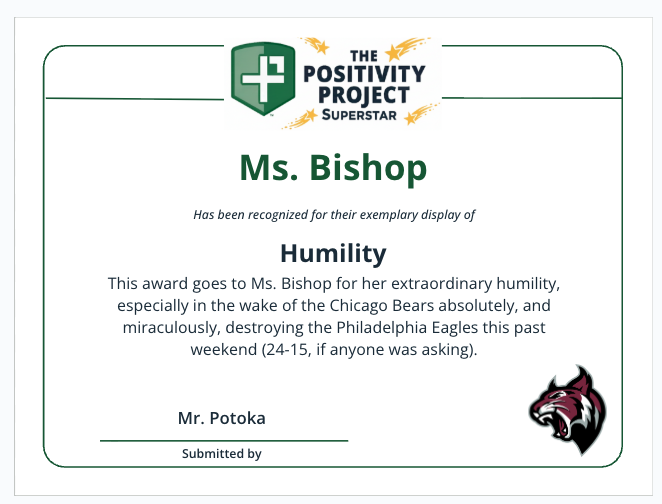
An example of the template that West Lake Middle uses to nominate students and staff exemplifying P2 character strengths. Kudos to Mr. Potoka for exemplifying the character strength of humor!